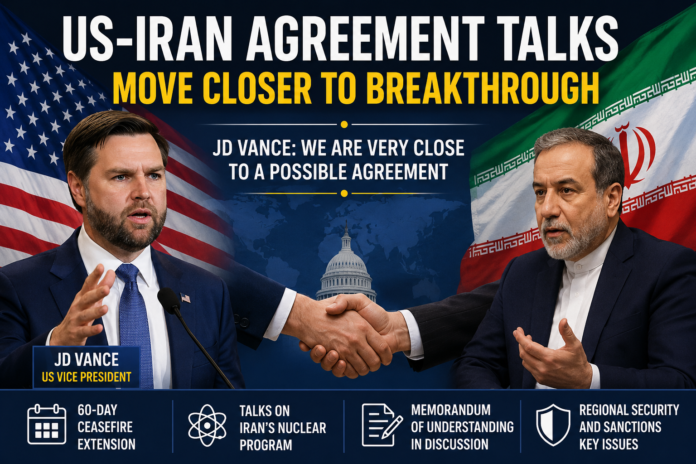
Tehran and Washington are moving closer to a possible diplomatic agreement, according to US Vice President JD Vance, who said negotiations between the two countries have made significant progress in recent weeks.
Speaking to reporters in Washington, Vance stated that although a final agreement has not yet been reached, both sides are “very close” to a possible deal. He added that ongoing discussions are mainly focused on extending the current 60-day ceasefire and addressing concerns related to Iran’s nuclear programme.
According to the US Vice President, Iran appears interested in reaching an agreement with the United States, while Washington also sees diplomacy as the preferred path forward. However, several major issues still remain unresolved before any formal deal can be approved.
Vance explained that negotiations are continuing on a number of key points and that President Donald Trump is not yet ready to officially approve the proposed arrangement. He said the American administration wants additional progress before the agreement can move toward ratification.
The Vice President also stressed that the United States remains capable of further limiting Iran’s nuclear activities if necessary. At the same time, he emphasised that any long-term solution would require detailed negotiations, firm commitments, and clearly defined conditions from both sides.
When asked about the possible timeline for signing a Memorandum of Understanding (MoU), Vance said it was still too early to predict when President Trump might formally approve the document. He noted that diplomatic discussions are highly sensitive and require careful coordination before any final announcement can be made.
Earlier, American news outlet Axios reported that US and Iranian negotiators had agreed on a 60-day memorandum aimed at extending the ceasefire and beginning broader talks regarding Iran’s nuclear programme. According to the report, the proposed memorandum could become one of the most significant diplomatic breakthroughs since tensions between the two countries escalated.
The report further stated that despite recent progress, difficult negotiations still lie ahead. Major topics expected to dominate future talks include Iran’s nuclear development, economic sanctions imposed by the United States, and wider regional security concerns in the Middle East.
v
Sources quoted by Axios also claimed that President Trump has not yet formally approved the proposed agreement, indicating that discussions within the US administration are still ongoing.
Political analysts believe that if the agreement succeeds, it could help reduce tensions across the region and open the door for more stable relations between Tehran and Washington after years of hostility and diplomatic deadlock.
Although no official agreement has been signed so far, the latest statements from US officials suggest that both sides may be closer than ever to achieving a temporary diplomatic understanding that could shape future negotiations between the two longtime rivals.

