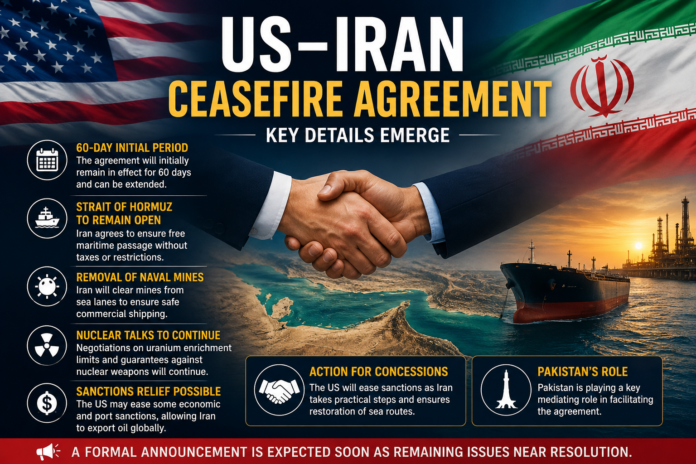
Officials from the United States and Iran are reportedly nearing a major diplomatic breakthrough after key details of a proposed ceasefire and economic agreement surfaced in international media reports. The developing deal could reduce tensions in the Middle East, reopen critical maritime routes, and ease pressure on global oil markets.
According to reports, both countries have agreed in principle to a memorandum of understanding (MoU) that would initially remain in effect for 60 days. The agreement could later be extended if both sides continue to cooperate and fulfill their commitments.
One of the most significant elements of the proposed agreement involves the Strait of Hormuz, one of the world’s most important oil shipping routes. Iran has reportedly agreed to guarantee free and uninterrupted maritime movement through the strategic waterway without imposing additional taxes, restrictions, or barriers on international vessels.
Sources also claim that Iran has committed to removing naval mines allegedly placed in important sea lanes. This step is expected to restore confidence among international shipping companies and allow commercial trade operations to return to normal levels after months of regional uncertainty.
Diplomatic negotiations concerning Iran’s nuclear program are also expected to continue during the temporary agreement period. US officials are reportedly seeking firm guarantees that Iran will not pursue nuclear weapons development in the future. At the same time, discussions are ongoing regarding limits on uranium enrichment activities and the handling of sensitive nuclear material reserves.
In return for Iranian cooperation, Washington is considering partial relief from economic and port-related sanctions. Reports suggest that Iran may be allowed to freely export oil to global markets under the proposed arrangement. Analysts believe this development could significantly strengthen Iran’s struggling economy while also helping stabilize international oil prices, which have remained volatile due to regional conflicts and supply concerns.
The agreement reportedly follows an “action for concessions” framework. Under this approach, the United States would gradually ease sanctions as Iran takes measurable steps to restore maritime security and fulfill other commitments outlined in the deal.
However, several issues still remain unresolved. Iranian officials are reportedly pushing for the immediate release of frozen financial assets and the permanent removal of sanctions. The US position, according to diplomatic sources, is that broader economic relief can only happen after Iran demonstrates practical compliance with the agreement over time.
The proposed understanding may also include provisions aimed at reducing tensions between Hezbollah and Israel, an issue that has contributed heavily to instability across the Middle East in recent months. Although details remain limited, diplomats believe broader regional de-escalation efforts are connected to the negotiations.
Pakistan is also said to be playing an important behind-the-scenes role in facilitating communication between the two sides. Reports indicate that Pakistani military leadership, including Field Marshal Asim Munir, has participated in diplomatic efforts through meetings and discussions held in Tehran and other regional capitals.
US sources suggest that negotiators are working to finalize the remaining issues within hours. If successful, a formal announcement could soon follow, potentially marking one of the most significant diplomatic developments between Washington and Tehran in recent years.
Experts say that while the proposed agreement may not resolve every long-term dispute between the two countries, it could serve as an important first step toward reducing regional tensions, restoring economic stability, and preventing further military escalation in the Gulf region.
FAQ: US–Iran Proposed Ceasefire and Agreement
1. What is the proposed agreement between the US and Iran?
The proposed agreement is a temporary memorandum of understanding (MoU) aimed at reducing tensions between the United States and Iran. It includes a 60-day ceasefire framework, maritime security measures, and discussions on nuclear issues and sanctions relief.
2. How long will the initial agreement last?
The initial phase of the agreement is reportedly set for 60 days. However, it can be extended if both countries agree and continue to meet the terms of the deal.
3. What changes are expected in the Strait of Hormuz?
Iran is expected to ensure free and uninterrupted maritime traffic through the Strait of Hormuz. This includes removing any restrictions, avoiding additional taxes, and reportedly clearing naval mines from shipping lanes.
4. Will Iran be allowed to export oil?
Yes, under the proposed deal, the United States is considering easing some sanctions, which could allow Iran to resume or expand oil exports to global markets.
5. What is the US demand regarding Iran’s nuclear program?
The United States is seeking assurances that Iran will not develop nuclear weapons. Talks also include limits on uranium enrichment and the management of sensitive nuclear materials.
6. Are US sanctions on Iran being lifted completely?
No, sanctions are not expected to be fully lifted immediately. The US is considering gradual or partial relief based on Iran’s compliance and concrete actions under the agreement.
7. What does “action for concessions” mean in this deal?
It means that the US will ease sanctions step-by-step as Iran takes verified actions, such as restoring maritime security and complying with agreed conditions.
8. Is Pakistan involved in the negotiations?
Reports suggest that Pakistan is playing a mediating role in facilitating discussions between the US and Iran. Pakistani leadership has reportedly supported diplomatic engagement efforts.
9. Could this agreement affect global oil prices?
Yes, analysts believe that if Iran resumes oil exports, it could help stabilize global oil prices by increasing supply and reducing market uncertainty.
10. Is this agreement final?
No, the agreement is not final yet. According to sources, negotiations are ongoing, and a formal announcement may be made once remaining issues are resolved.

