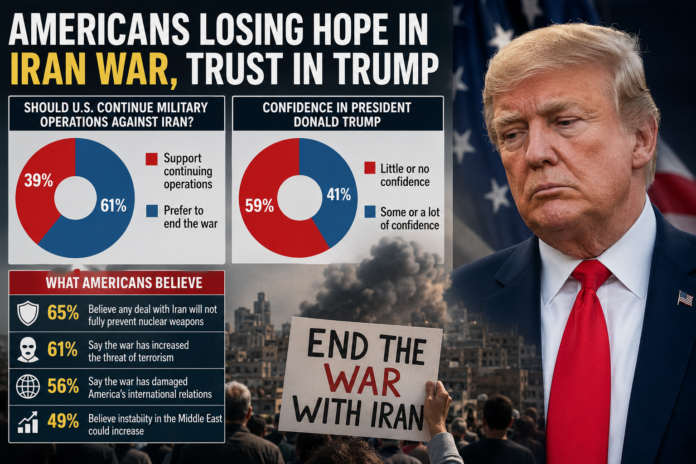
Recent opinion polls in the United States indicate a significant shift in public sentiment regarding the ongoing tensions with Iran. A growing number of Americans are expressing skepticism about continued military involvement and uncertainty over whether the United States can achieve its long-term objectives in the region. At the same time, confidence in political leadership, including President Donald Trump, has also declined, according to multiple surveys.
Political analysts suggest that this change in public opinion could influence future U.S. foreign policy decisions and reshape the broader political landscape ahead of upcoming elections. Increasing war fatigue, economic concerns, and fears of global instability appear to be driving this shift toward diplomatic solutions.
A recent survey conducted by Fox News found that only 39 percent of American voters support continuing military operations related to Iran. In contrast, a clear majority favors de-escalation and an eventual end to hostilities. This reflects a growing reluctance among citizens to support prolonged overseas conflicts.
Similarly, a joint poll by The New York Times and Siena College revealed that 52 percent of respondents support ending the conflict with Iran. Many participants in the survey expressed concern that continued tension could increase risks not only for the United States but also for broader regional stability in the Middle East.
Another survey by The Washington Post and ABC News highlighted that 65 percent of Americans believe any potential agreement with Iran may still fail to fully prevent nuclear development. This indicates a widespread sense of doubt about the effectiveness of diplomatic negotiations in achieving long-term security goals.
A broader report from the Pew Research Center further supports this trend, showing that two-thirds of Americans lack confidence in the U.S. achieving its objectives in Iran. Additionally, 61 percent of respondents believe that ongoing conflict has increased the threat of terrorism, while 56 percent say it has negatively affected America’s international relationships. Nearly half also fear that instability in the Middle East could continue to rise if tensions persist.
In a separate poll conducted by CNN, 59 percent of Americans reported having little or no confidence in President Donald Trump. Analysts note that declining trust in leadership, combined with war fatigue, may push policymakers toward more cautious and diplomatic strategies in the future.
Experts argue that prolonged conflict, rising financial costs, and increasing global uncertainty are encouraging the American public to prioritize negotiation over military action. As a result, policymakers may face growing pressure to reconsider their approach toward Iran and focus more on long-term diplomatic engagement rather than escalation.
Overall, the data suggests a clear shift in American public opinion: a preference for ending military tensions and seeking peaceful resolutions, even amid ongoing geopolitical concerns.
FAQ
1. What do recent surveys say about the Iran conflict?
Most surveys show that a majority of Americans prefer ending the conflict and reducing military involvement in Iran.
2. How many Americans support continuing military action?
According to Fox News polling, only about 39 percent support ongoing military operations.
3. Do Americans trust diplomatic efforts with Iran?
Many Americans are skeptical, with 65 percent believing a deal may not fully prevent nuclear development.
4. How is Donald Trump viewed in recent polls?
CNN polling shows that around 59 percent of Americans have little or no confidence in President Donald Trump.
5. What is the main concern of the American public?
Key concerns include war fatigue, economic costs, terrorism risks, and global instability.
6. Could this shift affect U.S. politics?
Yes, analysts believe changing public opinion could significantly influence future U.S. foreign policy and elections.

