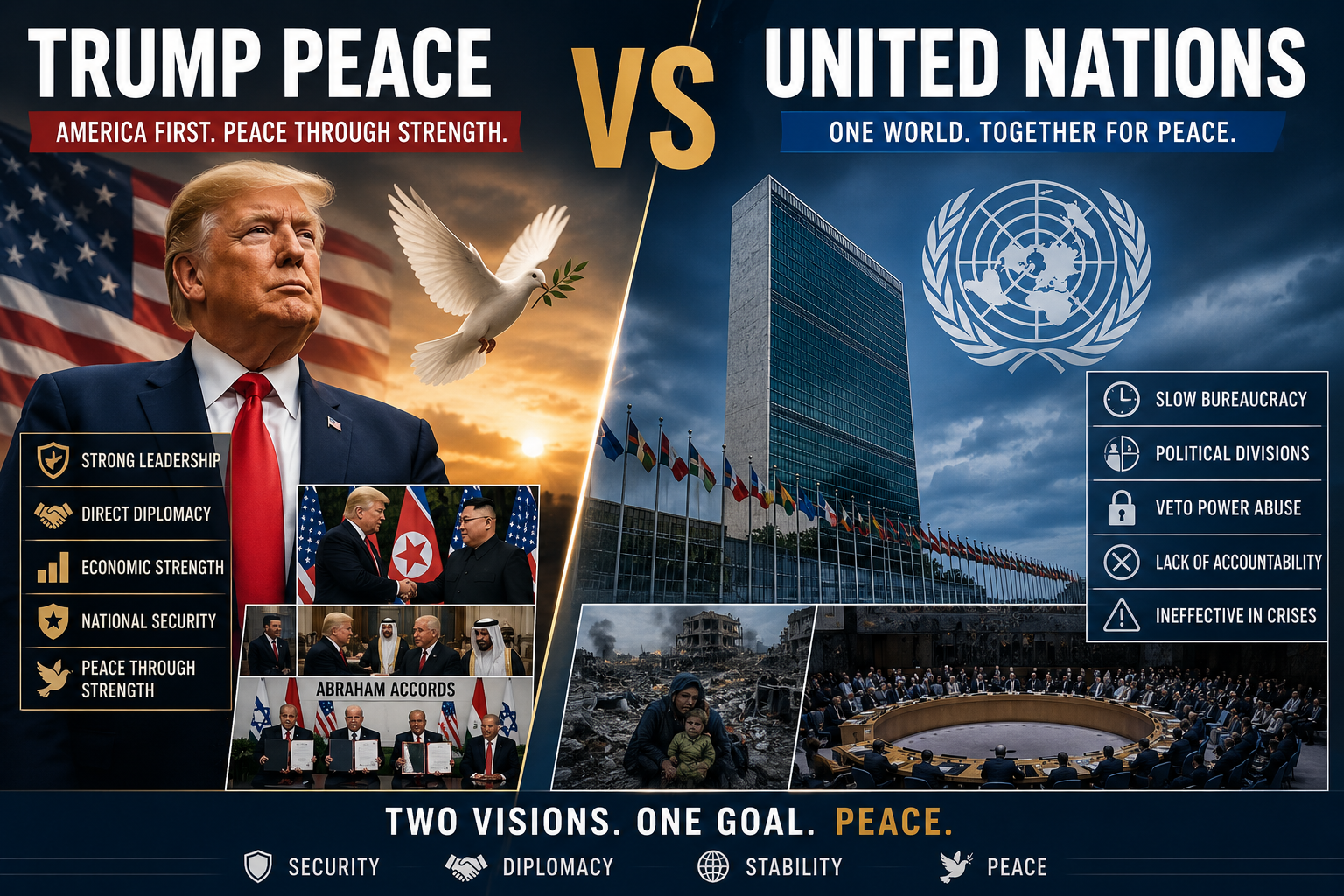
The idea that strong political leadership can shape global peace has once again entered international debate, especially with renewed discussions surrounding former U.S. President Donald Trump. Supporters often claim that “if there is Trump, there is peace,” pointing to the absence of major new wars during his presidency and his unconventional diplomatic style. At the same time, new proposals for alternative global peace platforms — sometimes described as a “Peace Board” — are raising questions about whether such bodies could one day rival the United Nations.
The Rise of the “Peace Through Strength” Narrative
During his presidency, Donald Trump promoted a foreign policy based on economic pressure, direct negotiations, and reduced military intervention abroad. His supporters argue that this strategy prevented several global conflicts from escalating.
One of the most notable examples was the signing of the Abraham Accords, which normalised relations between Israel and several Arab nations. Trump also held historic meetings with North Korean leader Kim Jong Un, an event many believed impossible only a few years earlier.
Critics, however, argue that the appearance of stability did not necessarily mean lasting peace. Tensions with Iran, trade disputes with China, and strained relations with NATO allies showed that Trump’s approach often created uncertainty alongside diplomacy.
Even so, the slogan “If there is Trump, there is peace” continues to resonate among supporters who believe his negotiation tactics were more effective than traditional international diplomacy.
What Is the “Peace Board”?
The term “Peace Board” is increasingly being used to describe the concept of a smaller, more decisive international alliance focused purely on conflict prevention and rapid diplomatic action. Unlike the United Nations, which includes nearly every recognised country in the world, a Peace Board would likely involve only influential powers and strategic allies.
Supporters of such an idea argue that the United Nations has become too slow and politically divided to handle modern crises effectively. Veto powers within the UN Security Council often prevent swift action, particularly during conflicts involving major global powers.
A Peace Board, according to proponents, could operate with fewer bureaucratic barriers and focus on immediate mediation, economic cooperation, and security guarantees.
Why Some Believe the United Nations Is Losing Influence
Founded after World War II, the United Nations was created to prevent future global conflicts and encourage international cooperation. For decades, it played a major role in peacekeeping missions, humanitarian aid, and diplomatic negotiations.
However, recent global conflicts have exposed several weaknesses in the organisation. Critics point to the ongoing wars in Ukraine and Gaza, where divisions among powerful member states have limited unified action.
Many nations also believe the UN structure reflects the political realities of 1945 rather than today’s multipolar world. Emerging powers often argue that decision-making authority remains concentrated among a few countries.
This frustration has opened the door to discussions about alternative systems capable of responding more quickly to international crises.
Could a Peace Board Truly Rival the United Nations?
While the concept sounds appealing to some political observers, replacing or rivaling the United Nations would be extremely difficult.
The UN possesses global legitimacy, established institutions, international courts, peacekeeping forces, and humanitarian agencies operating across the world. A new Peace Board would need widespread international recognition and long-term trust to achieve similar influence.
Another challenge is neutrality. The United Nations, despite its flaws, is viewed as a global institution rather than the project of one leader or one country. A Peace Board associated too closely with Donald Trump or any single political movement could struggle to gain support from rival nations.
There is also the issue of continuity. Governments change, elections shift priorities, and international alliances evolve. Any new organisation would require stable leadership and global cooperation beyond individual personalities.
Trump’s Global Appeal and Criticism
Donald Trump remains one of the most influential and polarising political figures in modern history. Some world leaders admire his directness and business-oriented negotiation style. Others believe his policies weakened international alliances and increased political division.
His supporters argue that his willingness to challenge diplomatic norms produced practical results. Opponents counter that long-term peace requires predictable institutions rather than personality-driven diplomacy.
Regardless of political opinion, Trump’s influence on international discussions about power, security, and peace remains significant.
The Future of Global Peace Organisations
The debate surrounding a possible Peace Board reflects a larger global concern: many people feel existing international institutions are struggling to keep pace with modern geopolitical challenges.
Rather than replacing the United Nations entirely, future peace initiatives may emerge as complementary organisations focused on regional mediation, economic partnerships, or emergency diplomacy.
The world is becoming increasingly complex, with cyber warfare, economic conflicts, and shifting alliances changing the nature of global security. Whether led by traditional institutions like the United Nations or newer initiatives inspired by leaders such as Donald Trump, the demand for effective peace-building mechanisms will only continue to grow.
Conclusion
The phrase “If there is Trump, there is peace” captures the belief among many supporters that strong and unconventional leadership can reduce global conflict. At the same time, discussions about creating a “Peace Board” reveal growing dissatisfaction with the pace and structure of the United Nations.
Although a new peace-focused alliance could influence international diplomacy, rivaling the United Nations would require enormous global support, credibility, and long-term stability. For now, the UN remains the world’s central platform for international cooperation, even as debates about reform and alternative approaches continue to intensify.

