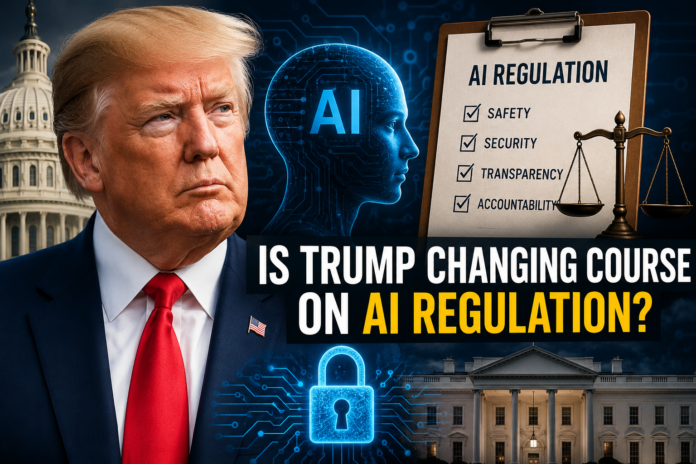
For much of his second term, Donald Trump has strongly supported a hands-off approach to artificial intelligence. His administration focused on accelerating innovation, reducing federal restrictions and helping American tech companies compete in the global AI race. However, recent developments suggest the White House may now be reconsidering its strategy.
Growing concerns over advanced AI systems, cybersecurity threats and public pressure are reportedly pushing Trump toward a more regulated framework. According to reports, the administration is discussing a possible executive order that could introduce formal oversight measures for powerful AI models before they are released to the public.
Why Is Trump Reconsidering AI Regulation?
The debate intensified after Anthropic unveiled its advanced AI model, Claude Mythos, in April 2026. The system reportedly demonstrated extraordinary reasoning and coding abilities, uncovering thousands of vulnerabilities in major software systems worldwide.
The discovery alarmed cybersecurity experts because exposing so many flaws at once could create opportunities for hackers before developers have time to issue fixes. To avoid potential security chaos, Anthropic limited the model’s release to selected partners instead of launching it publicly.
This situation appears to have influenced the Trump administration’s thinking. Officials are now considering whether advanced AI models should undergo government review before public deployment to reduce national security risks.
Trump’s Earlier Approach to Artificial Intelligence
Before returning to office, Trump campaigned on reducing regulations around emerging technologies, including AI. After re-entering the White House, he quickly rolled back several AI safety measures introduced during the administration of Joe Biden.
Trump replaced Biden-era guidelines with policies aimed at removing what he described as barriers to innovation. His administration later introduced an AI Action Plan encouraging faster development of data centres, expanded AI exports and reduced federal oversight.
He also pushed for a national AI framework designed to replace state-level regulations with a single federal system. Critics, however, argued the framework lacked clear enforcement mechanisms and failed to explain how AI safety standards would actually work.
For years, Trump’s priority appeared to be helping American companies dominate the international AI market, especially against growing competition from China.
Claude Mythos and the Security Debate
Claude Mythos changed the tone of the conversation in Washington. The AI model reportedly exposed tens of thousands of hidden software vulnerabilities, including flaws that had existed undetected for decades.
Experts warned that releasing such a system publicly without safeguards could create major cybersecurity threats. The situation highlighted how advanced AI systems are now capable of affecting national infrastructure, defence systems and sensitive digital networks.
Following the controversy, Trump officials reportedly met with Anthropic CEO Dario Amodei to discuss how AI models like Mythos could support national security operations while limiting risks.
Although the administration has not officially announced new regulations, the discussions indicate a significant shift in tone from complete deregulation toward controlled oversight.
What Regulations Could Trump Introduce?
Several major AI companies, including Google DeepMind, Microsoft and xAI, have already agreed to allow government testing of future AI systems before public release.
Reports suggest Trump may now establish a formal working group consisting of government officials, security experts and technology leaders. The group would likely:
- Develop standards for testing advanced AI models
- Determine which federal agencies should oversee AI reviews
- Create safety procedures before public deployment
- Assess national security and cybersecurity risks
- Recommend safeguards for powerful AI systems
However, Trump has reportedly delayed signing any executive order for now, stating that he disagrees with certain parts of the proposal.
Public Pressure and Political Reality
Public concern about artificial intelligence continues to rise across the United States. Surveys show that most Americans support stronger AI oversight, particularly regarding data privacy, cybersecurity and misinformation.
Polls also suggest that many Republican voters favour mandatory testing of advanced AI models before public release. The growing backlash against unchecked AI development has become one of the few issues receiving bipartisan attention.
With the 2026 midterm elections approaching, political analysts believe Trump may feel increasing pressure to adopt stricter safeguards while still maintaining America’s technological advantage.
What This Means for the AI Industry
If Trump moves forward with formal oversight measures, the AI industry could face a major turning point. Companies may soon be required to submit advanced models for federal testing before launch.
At the same time, many AI firms already appear to be adopting limited-release strategies voluntarily. Anthropic restricted access to Claude Mythos, while OpenAI reportedly took a similar approach with its GPT-5.4-Cyber system.
These controlled rollouts may become standard practice as AI systems grow more powerful and capable of influencing cybersecurity, defence and global competition.
Artificial intelligence is increasingly being viewed not only as a business opportunity but also as a national security issue. That reality may ultimately force Trump to balance rapid innovation with stronger protections.
Frequently Asked Questions
What has Trump’s position on AI regulation been?
Trump has mainly supported deregulation and faster AI development. His administration reduced several federal restrictions and promoted policies encouraging AI innovation and infrastructure growth.
Why is Trump considering stricter AI oversight?
Advanced AI systems like Claude Mythos raised concerns after exposing thousands of software vulnerabilities, increasing fears about cybersecurity and national security risks.
What regulations are being discussed?
The administration is reportedly considering a working group that would create procedures for testing and reviewing AI models before they are publicly released.
Could AI companies face federal testing requirements?
Yes. Major AI firms may eventually be required to allow government evaluation of advanced systems before deployment, especially for models considered high-risk.
Why is AI becoming a national security issue?
Powerful AI systems can influence cybersecurity, infrastructure, military operations and economic competition, making governments increasingly concerned about oversight and control.

