Is AI Already Thinking for Us?
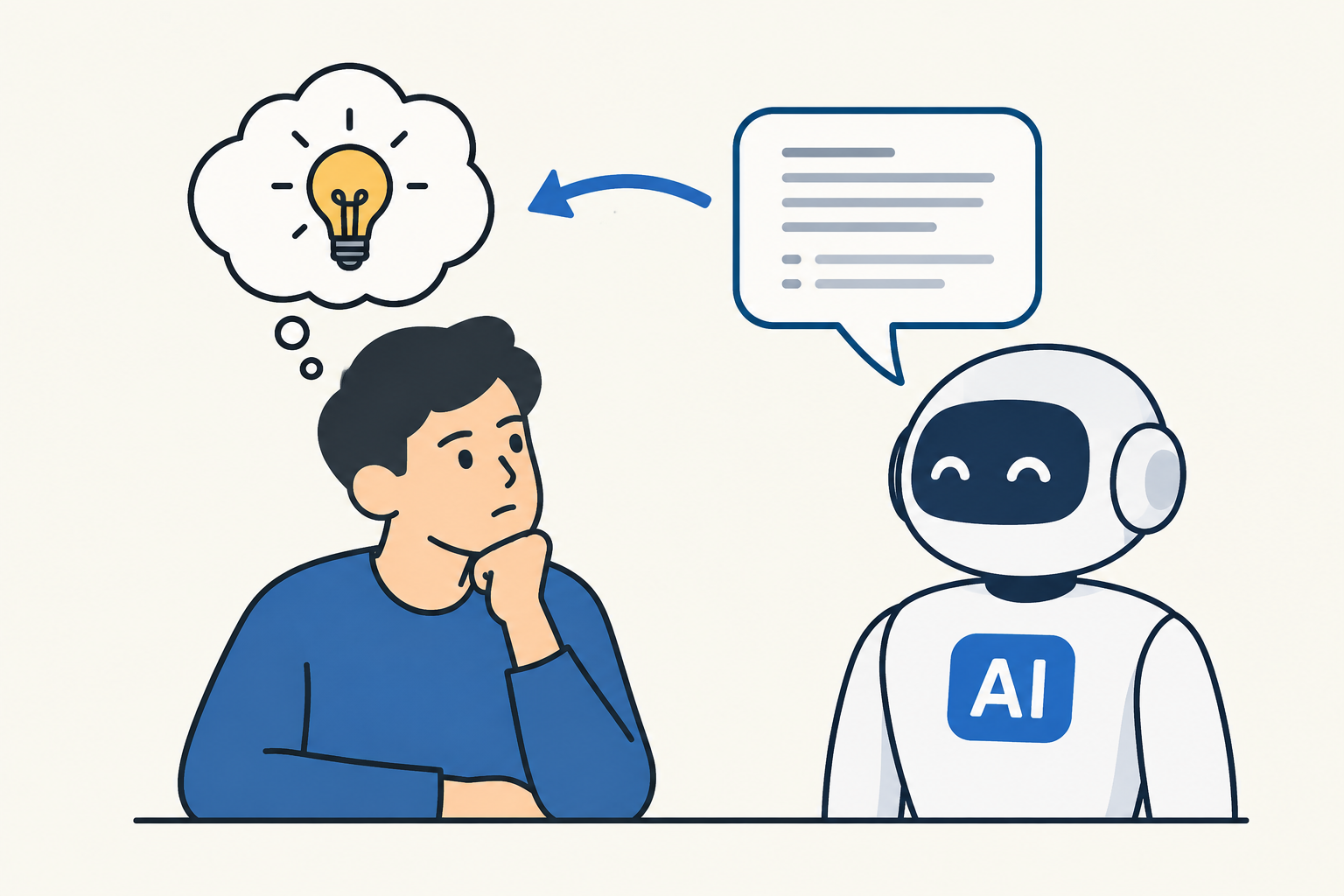
The biggest threat AI poses to humanity may not be killer robots or rogue algorithms, but the gradual loss of independent thought.
Summary: Artificial intelligence is changing more than how we work. By generating summaries, outlines, emails, and first drafts, AI can influence how we approach ideas before we have a chance to form our own opinions. The result could be a culture of increasingly similar language, arguments, and perspectives — a quiet movement toward a more uniform way of thinking.
The traditional fear surrounding artificial intelligence has always been that machines would eventually become smarter than humans and take control.
But perhaps the more immediate concern is much quieter.
AI may already be influencing the way we think.
Every time we ask an AI system to summarize a book, write the first draft of an email, explain a complicated subject, or develop an argument, we hand over something important: the opportunity to begin thinking for ourselves.
The beginning matters. The person who presents an argument first often establishes its framework. The first summary can influence how a reader understands an entire book. When AI provides that starting point, it can subtly shape the direction of our thoughts before we have developed our own.
Over time, this convenience could affect more than productivity. It could affect individuality.
How Does AI Influence Human Thinking?
The concern is not simply that machines will replace human workers. A deeper issue is whether people will gradually stop developing their own ideas.
AI can make writing faster and more polished, but it can also encourage standardized language and familiar patterns of expression. If millions of people rely on similar systems to generate their ideas, the differences between individual voices may begin to disappear.
The result could be a world where everyone communicates clearly — but increasingly sounds the same.
The Rise of the Uniform Mind
Large language models do not think in the same way humans do. They generate language by identifying patterns and predicting what words and ideas are likely to come next.
That ability makes them remarkably useful. But it also creates a tendency toward familiarity and convergence.
Ask an AI system to summarize Crime and Punishment, for example, and it can produce an explanation within seconds. Ask another person to do the same thing, and their interpretation may focus on completely different themes, characters, emotions, or philosophical questions.
AI-generated summaries can make information accessible, but repeated reliance on them may narrow the range of interpretations people encounter.
Yuval Noah Harari has raised concerns about AI’s potential to centralize meaning and influence how people understand information. Historically, a book could produce thousands of interpretations because every reader approached it with a different background and perspective.
AI-generated summaries introduce another possibility: many people consuming essentially the same interpretation.
The danger, therefore, may not be that people stop reading. It may be that they increasingly encounter the same conclusions before they have had the opportunity to form their own.
Effort May Be the Last Refuge
French philosopher Raphaël Enthoven has argued in L’Esprit Artificiel that genuine thinking requires effort. That idea becomes increasingly relevant in an age when AI can provide instant explanations for almost anything.
Why struggle through Kant or Kierkegaard when an AI system can provide their central ideas in thirty seconds?
The convenience is undeniable. But difficulty can serve a purpose.
Working through a difficult book forces us to question, misunderstand, reconsider, and eventually develop our own interpretation. The struggle itself becomes part of the learning process.
This does not necessarily mean AI is harmful. The problem emerges when convenience replaces engagement entirely.
Étienne de La Boétie described a form of voluntary servitude in which people surrender freedom not because they are forced to do so, but because doing so becomes easier.
Something similar could happen with intellectual work.
Nobody is forcing us to outsource every email, outline, summary, or idea. We choose to do it because it saves time.
But when enough small intellectual tasks are delegated, we may gradually become less accustomed to doing the thinking ourselves.
The question is not whether AI can think on our behalf.
It is whether we will continue choosing to think before asking it to do so.
Losing the Self in the Machine
Søren Kierkegaard warned about what he called “the crowd” — the tendency for individual identity to disappear within a larger collective.
Modern AI introduces a new version of that problem.
AI-generated writing often appears polished, organized, and professional. Yet the same qualities can make it feel interchangeable.
Human writing contains imperfections. A strange metaphor. An unusual sentence. A personal expression. A sudden change in rhythm. Sometimes even a grammatical mistake can reveal something about the person behind the words.
AI tends to smooth these imperfections away.
Friedrich Nietzsche similarly criticized what he described as “herd morality” in Beyond Good and Evil — the tendency to prioritize conformity and safety over individuality and creation.
AI can unintentionally reinforce this tendency.
We might call it the “will to autocomplete.”
Instead of struggling to find the right idea, we accept the first plausible suggestion. Instead of developing an unusual argument, we choose the polished version. Instead of discovering our own voice, we allow the machine to provide one.
AI may not be deliberately making us conform.
But by constantly predicting the most likely continuation, it can encourage us toward language and ideas that are already familiar.
But Isn’t This Progress?
There is a legitimate argument on the other side.
Standardization can be useful.
AI-generated summaries can help people understand complicated subjects quickly. Automated drafts can eliminate repetitive work. Standardized communication can save businesses enormous amounts of time.
AI may even give people more freedom to focus on creative and meaningful tasks.
Efficiency is not inherently a problem.
The real question is what we do with the time AI gives back to us.
Steve Jobs famously emphasized the idea of “Think Different.” That philosophy celebrated originality rather than simply producing the most efficient or conventional answer.
AI is extremely good at producing useful answers based on existing patterns. But originality often begins somewhere else — with uncertainty, experimentation, mistakes, and ideas that initially seem strange.
So the important question is not whether AI is useful.
It clearly is.
The question is whether we will still know how to think independently after AI has become responsible for the first draft of everything.
The Last Authentic Act
A reaction against AI-generated content is already emerging in some areas. Employers may ask applicants to write without AI assistance. Educators may require handwritten work or supervised assignments. Readers increasingly look for personal experiences and imperfections that signal genuine human involvement.
In a world filled with polished machine-generated content, imperfection can become evidence of authenticity.
The biggest risk of AI taking over human thought may therefore not arrive in the form of a dramatic technological event.
It may happen gradually.
It may look like millions of people using the same tools, receiving similar suggestions, adopting similar phrases, and eventually developing increasingly similar ways of expressing ideas.
The simplest response may also be the most important.
Read the book without immediately searching for its summary.
Sit with a difficult question before asking AI for the answer.
Write the first paragraph yourself.
Allow an idea to remain incomplete for a while.
Make a mistake.
Develop an opinion that does not sound perfectly polished.
The goal is not to reject AI. It is to make sure that convenience does not replace curiosity, and assistance does not replace individuality.
Because when AI always thinks first, the thing we risk losing may not simply be our words.
It may be the distinctive way each of us thinks before those words ever exist.
Frequently Asked Questions
1. Is AI already influencing how humans think?
Yes. AI can influence thinking by generating summaries, ideas, outlines, and first drafts before people develop their own perspectives.
2. What is the biggest concern about AI and human thought?
One concern is the loss of individuality. If people repeatedly rely on AI for ideas and writing, their language and perspectives may become increasingly similar.
3. Do AI systems actually think like humans?
No. Large language models generate responses by recognizing patterns in data and predicting likely sequences of words rather than thinking and experiencing the world like humans.
4. Can AI reduce human creativity?
It can if people rely on it too heavily. Using AI as a replacement for brainstorming, experimentation, and personal expression may reduce opportunities to develop original ideas.
5. Is using AI for writing necessarily harmful?
No. AI can be a useful tool for improving productivity, organizing information, and handling repetitive tasks. The concern arises when it completely replaces independent thinking.
6. How can people maintain independent thinking while using AI?
People can develop their own ideas before asking AI for assistance, read original sources, question AI-generated answers, and preserve their personal writing style and opinions.