Introduction
Artificial intelligence continues to reshape the technology industry at an unprecedented pace, and June 2026 has proven to be one of the busiest months for AI innovation. Every week, technology companies introduce new AI-powered software designed to improve coding, automate workflows, create digital content, and help businesses operate more efficiently.
This week alone, several major software releases have captured the attention of developers, businesses, and technology enthusiasts. From advanced coding models to enterprise AI platforms and powerful creative tools, these launches highlight how artificial intelligence is becoming an essential part of everyday work.
Whether you’re a software developer looking for smarter coding assistants, a business owner seeking productivity tools, or simply someone interested in the future of AI, these latest releases offer valuable insights into where the industry is heading.
In this article, we’ll explore the biggest AI software releases launched during June 2026, explain their features, compare their capabilities, and discuss how they could impact developers, businesses, and consumers worldwide.
Why AI Software Is Advancing So Quickly
Artificial intelligence is no longer limited to chatbots or simple automation tools. Companies are now investing billions of dollars into AI research to create software capable of solving increasingly complex problems.
Several factors are driving this rapid innovation:
- Growing demand for AI-powered productivity tools.
- Increased investment from major technology companies.
- Faster and more efficient AI chips.
- Expansion of open-source AI models.
- Strong demand for enterprise automation.
- Improved cloud computing infrastructure.
- Better AI safety and security practices.
As competition increases, software vendors are releasing updates more frequently than ever before, giving users access to smarter and more capable AI applications.
The Biggest AI Software Releases This Week
This week’s announcements cover nearly every area of artificial intelligence, including software development, image creation, automation, enterprise management, and research.
Some of the most notable categories include:
- AI coding assistants
- Open-source language models
- Enterprise AI software
- Image generation platforms
- AI workflow automation
- Productivity applications
- Developer platforms
Each release focuses on improving speed, accuracy, usability, and security.
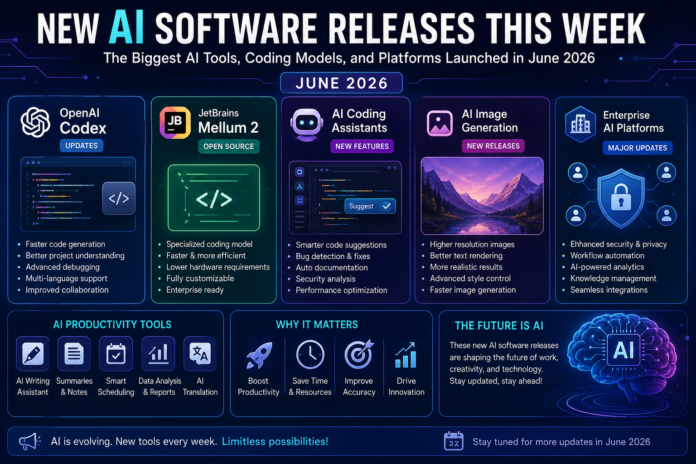
OpenAI Expands Codex
One of the biggest announcements this week involves the continued expansion of OpenAI’s Codex platform.
Codex has become one of the most capable AI coding assistants available, helping developers write code, fix bugs, explain complex programming concepts, and generate documentation.
New Features
The latest improvements include:
- Faster response times
- Better project understanding
- Improved debugging
- Smarter code suggestions
- Multi-language programming support
- Better collaboration features
- Enhanced code explanations
These updates allow developers to spend less time on repetitive coding tasks and more time designing innovative software.
Benefits
Codex now helps developers:
- Build applications faster
- Reduce programming errors
- Improve software quality
- Learn unfamiliar programming languages
- Generate documentation automatically
- Review large codebases
For startups and enterprise development teams alike, these improvements can significantly reduce development costs.
JetBrains Mellum 2 Goes Open Source
JetBrains introduced Mellum 2, an advanced coding model designed specifically for software development.
Unlike general-purpose language models, Mellum 2 focuses entirely on programming tasks, making it particularly effective for professional developers.
Major Improvements
The latest version offers:
- Better code completion
- Faster execution
- Improved understanding of project context
- Lower hardware requirements
- More efficient memory usage
- Open-source licensing
- Enterprise deployment options
Developers can customize the model for their own applications without relying solely on cloud-based AI services.
Why Open Source Matters
Open-source AI provides several important advantages:
- Greater transparency
- Lower operating costs
- Improved customization
- Better privacy
- Community-driven improvements
- Easier integration
Many organizations prefer open-source AI because they maintain full control over their software infrastructure.
AI Coding Assistants Continue to Improve
Coding assistants remain one of the fastest-growing segments of artificial intelligence.
Modern AI programming tools can now:
- Generate complete functions
- Write documentation
- Explain existing code
- Detect bugs
- Recommend improvements
- Optimize performance
- Suggest security fixes
Rather than replacing programmers, these assistants act as intelligent teammates that accelerate software development.
Developers report saving several hours each week by automating repetitive coding tasks.
Better Software Development
The newest generation of coding assistants offers major improvements over earlier AI tools.
Today’s systems understand:
- Entire projects instead of individual files.
- Programming context.
- Team coding standards.
- Documentation requirements.
- Software architecture.
- Testing procedures.
This deeper understanding results in more accurate code suggestions and fewer programming mistakes.
AI Image Generation Software
Creative AI software also saw significant improvements this week.
New image-generation platforms now produce:
- Higher-resolution artwork
- Better typography
- More realistic lighting
- Improved facial expressions
- Accurate object placement
- Faster rendering
These improvements make AI image tools increasingly useful for marketers, designers, publishers, and content creators.
Businesses are using these platforms to create advertising graphics, product illustrations, blog images, and social media content much faster than traditional design workflows.
AI Video Creation Continues to Improve
Video generation software is evolving rapidly.
Several companies announced improvements including:
- Longer video generation
- Better scene consistency
- More realistic animations
- Improved character movement
- Faster rendering
- Enhanced editing capabilities
AI-generated video is expected to become one of the fastest-growing creative technologies throughout 2026.
Enterprise AI Platforms Receive Major Upgrades
While AI tools for consumers continue to improve, enterprise software remains one of the fastest-growing sectors in artificial intelligence. This week, several companies introduced updates that help organizations deploy AI more securely while improving collaboration and workflow automation.
Modern enterprise AI platforms are designed to work with existing business systems, making it easier for organizations to integrate artificial intelligence into their daily operations without replacing their current software infrastructure.
New Enterprise Features
Recent platform updates include:
- Enhanced security controls
- Better permission management
- AI-powered document search
- Intelligent workflow automation
- Internal knowledge assistants
- Automated report generation
- Customer support automation
- Improved compliance monitoring
These features allow organizations to reduce manual work while improving accuracy and operational efficiency.
AI Productivity Software Becomes Smarter
Productivity software is one of the biggest winners in the AI revolution.
Today’s AI-powered applications can assist with nearly every office task, helping users save time and focus on more important work.
Common AI Productivity Features
- Writing emails
- Summarizing meetings
- Creating presentations
- Managing schedules
- Generating reports
- Translating documents
- Organizing notes
- Brainstorming ideas
Instead of switching between multiple applications, many modern AI platforms combine these capabilities into a single workspace.
AI for Content Creators
Content creation has changed dramatically thanks to artificial intelligence.
Writers, marketers, bloggers, YouTubers, and designers now use AI software to produce high-quality content much faster than traditional methods.
Popular use cases include:
- Blog writing
- SEO optimization
- Social media captions
- Product descriptions
- Video scripts
- Podcast outlines
- Marketing emails
- Image generation
AI speeds up the creative process while allowing professionals to spend more time refining ideas instead of starting from scratch.
AI Software for Businesses
Businesses of all sizes are adopting AI to improve customer service, reduce costs, and increase productivity.
Some of the most common business applications include:
Customer Support
AI chatbots now provide 24/7 assistance, answer common questions, and reduce support workloads.
Marketing
AI helps create advertising campaigns, analyze customer behavior, and optimize marketing performance.
Sales
Sales teams use AI to predict customer needs, automate follow-ups, and identify high-value leads.
Human Resources
Recruiters use AI to screen resumes, schedule interviews, and improve employee onboarding.
Finance
AI automates expense tracking, invoice processing, budgeting, and financial forecasting.
Software Development
Development teams rely on AI to write code, identify bugs, generate documentation, and improve software quality.
Comparison of This Week’s Biggest AI Releases
| Software | Primary Purpose | Best For | Key Advantage |
| OpenAI Codex | AI Coding | Developers | Faster programming and debugging |
| JetBrains Mellum 2 | Open-Source Coding Model | Software Engineers | Customizable code generation |
| AI Image Platforms | Image Creation | Designers & Marketers | High-quality visual content |
| Enterprise AI Platforms | Business Automation | Organizations | Secure workflow automation |
| Productivity AI Tools | Office Productivity | Professionals | Faster daily work |
Why Open-Source AI Is Growing
Open-source AI has become one of the biggest trends of 2026.
Developers appreciate the freedom to customize models, deploy them locally, and maintain complete control over their data.
Advantages include:
- Lower operating costs
- Better transparency
- Faster innovation
- Community improvements
- Improved privacy
- Flexible deployment
As more organizations prioritize data security, open-source AI will continue gaining popularity.
Challenges Facing AI Software
Despite rapid progress, AI software still faces several important challenges.
Data Privacy
Organizations must ensure sensitive information remains protected.
AI Hallucinations
Some AI systems occasionally generate inaccurate information that requires human verification.
Copyright Issues
Content creators continue debating how AI models should use copyrighted material during training.
Regulation
Governments worldwide are introducing new AI regulations that software companies must follow.
Workforce Adaptation
Businesses must train employees to work effectively alongside AI-powered tools.
Future AI Software Trends
Industry experts expect the next generation of AI software to include:
- Autonomous coding agents
- AI software engineers
- Fully multimodal AI assistants
- Advanced video generation
- Real-time translation
- Personalized AI workspaces
- AI-powered operating systems
- Smarter robotics software
Future AI platforms will increasingly understand voice, text, images, video, and real-world environments simultaneously.
What This Means for Developers
Developers should view AI as a productivity partner rather than a replacement.
The most successful software engineers will learn how to:
- Work with AI assistants
- Review AI-generated code
- Build AI-powered applications
- Fine-tune language models
- Improve software security
- Design better user experiences
AI will automate repetitive programming tasks while allowing developers to focus on solving complex business problems.
Conclusion
The latest AI software releases in June 2026 demonstrate that artificial intelligence is evolving faster than ever before. New coding models, enterprise platforms, creative tools, and productivity applications are making AI more useful across nearly every industry.
OpenAI’s expanded Codex capabilities, JetBrains’ open-source Mellum 2 model, and the continued advancement of AI image generation and enterprise automation highlight a clear industry trend: AI is becoming an essential tool for developers, businesses, and creators alike.
As competition between technology companies intensifies, users can expect even more innovative software releases throughout the rest of 2026. Organizations that adopt these technologies responsibly will be better positioned to improve efficiency, reduce costs, and stay competitive in an increasingly AI-driven world.
Frequently Asked Questions
1. What are the biggest AI software releases this week?
The biggest releases include OpenAI Codex updates, JetBrains Mellum 2, enterprise AI platforms, and improved AI image-generation tools.
2. What is OpenAI Codex used for?
It helps developers write, debug, explain, and optimize programming code.
3. Why is Mellum 2 important?
It is an open-source coding model specifically optimized for software development.
4. What industries benefit most from AI software?
Technology, healthcare, finance, education, marketing, manufacturing, and customer service.
5. Are AI coding assistants replacing developers?
No. They improve productivity by automating repetitive programming tasks.
6. What is enterprise AI?
Enterprise AI refers to artificial intelligence software designed for businesses to automate workflows and improve operations.
7. Why is open-source AI becoming popular?
It offers greater transparency, flexibility, privacy, and customization.
8. Can small businesses use AI software?
Yes. Many AI tools are affordable and suitable for businesses of all sizes.
9. What are the biggest AI trends in 2026?
Coding assistants, multimodal AI, workflow automation, video generation, and enterprise AI platforms.
10. Is AI software secure?
Most leading platforms include advanced security features, but organizations should still follow cybersecurity best practices.

