Introduction: The Quiet Transformation
In 2026, artificial intelligence is no longer announced. It simply *is*.
You interacted with multiple AI systems before finishing your morning coffee, and you probably didn’t realize it . This isn’t the dystopian takeover of science fiction—it’s the subtle, seamless integration of intelligence into the very fabric of daily existence. The revolution unfolding around us is characterised not by fanfare but by its silence.
Three years after ChatGPT became a global phenomenon, AI has accomplished what few technologies have achieved: it has become virtually invisible. Forrester’s latest consumer research shows that 38% of US online adults have used generative AI, and among global users, 62% engage with it at least weekly, with 24% using it daily . The trajectory suggests AI adoption will outpace even the smartphone revolution—not because it is more disruptive, but because it requires less effort. No new device to purchase. No steep learning curve. Just intelligence embedded into software people already use.
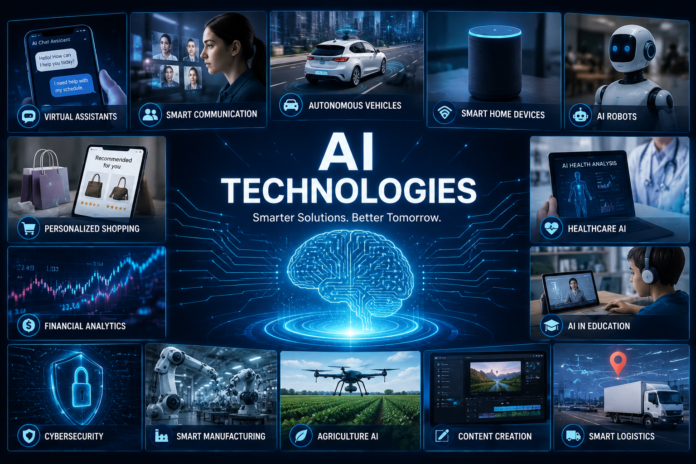
The real story of 2026 is not about chatbots or killer apps. It is about the 25 everyday AI technologies that have quietly become indispensable—tools so seamlessly integrated that many users do not even recognise them as AI . From the ambulance dispatch system in Abu Dhabi that routes patients based on real-time hospital capacity, to the Korean grandmother using HyperCLOVA X Think to decipher legal documents, to the student who never watches a full YouTube lecture anymore, this revolution is happening in plain sight, unnoticed by those living through it.
What follows is a comprehensive exploration of how 25 specific AI applications have reshaped daily life, organised across the domains where change is most profound.
1. The “Answer Engine” Replaces Search
The most fundamental shift in 2026 is how people find information. Search engines no longer return lists of blue links. They provide answers. Google’s AI now deciphers user intent, summarises top results from multiple sources, and delivers a complete answer at the top of the page . Two people entering the same query may receive different results based on location, search history, and browsing habits. The old paradigm of “finding information” has given way to “getting answers” .
This represents more than a convenience upgrade. Forrester data reveals that over 50% of online adults in every surveyed country have used generative AI as their primary “answer engine” . The zero-click phenomenon—where users never leave the search results page—has fundamentally disrupted the economics of content creation and digital advertising . Brands now must optimise not for search engine rankings but for AI discovery, designing experiences for conversational interfaces rather than traditional websites .
2. The Cognitive Partner at Work
Generative AI has evolved from a novelty productivity tool into an embedded cognitive partner. In the US, 49% of adults with advanced degrees now use AI at work, compared to only 24% of those with a high school education . The boundary between professional and personal use has blurred significantly, with many relying on tools like ChatGPT, Gemini, and Claude for everything from drafting emails to debugging code .
Yet the most telling statistic concerns depth of engagement: 62% of global users engage with Gen AI at least weekly, and one in five online adults now use it daily . For many, it has become a “second brain” —not a tool they consciously activate but a resource they naturally reach for when faced with any cognitive task.
3. The Companion in Your Pocket
Perhaps the most unexpected development of 2026 is the emergence of AI as a companion rather than merely a tool. In both the US (27%) and the UK (31%), consumers report using generative AI tools as both digital assistants and emotional supports . Users describe the technology as non-judgmental, emotionally supportive, and always accessible—qualities that encourage deeper engagement and routine use .
The phenomenon is particularly pronounced among younger demographics. Forrester projects that 20% of Gen Zers and Gen Alphas will succumb to AI companions in 2026 . In South Korea, 25% of teens now spend an average of 2 hours and 45 minutes per day interacting with the zeta chatbot . These are not mere distractions—they are relationships, filling emotional and social gaps in ways previous generations could not have imagined.
4. The Personalised Digital Curator
Social media feeds, curated news digests, and product recommendations are all orchestrated by AI algorithms analysing clicks, dwell time, and preferences . These systems create unique digital ecosystems for every individual, maximising engagement and revenue. Users rarely question why they see specific content or advertisements—the curation has become so seamless that the mechanism itself has faded from awareness.
5. The Korean Sovereign Assistant
In South Korea, something remarkable has happened. HyperCLOVA X Think, Naver’s sovereign Korean reasoning model, has become the default assistant for an entire country. Not through superior benchmark scores, but through distribution and cultural fluency . Embedded in Naver Search, Naver Works, Naver Map, and LINE Korea, it reaches most Korean adults across at least one app they already use daily .
The usage pattern looks less like Silicon Valley demos and more like domestic administration—and that is the point. Koreans use it to summarise long KakaoTalk threads, translate formal Korean into English for work emails, draft condolence messages with appropriate cultural register, and handle bureaucratic forms . It handles Korean honorifics and cultural nuance in ways global assistants still stumble over . The lesson is profound: distribution beats breakthroughs. Whatever domestic super-app embeds a culturally fluent assistant first defines that country’s AI defaults for a generation.
6. Ambient AI in the Living Room
Amazon calls it “ambient AI”—intelligence that works in the background, present when needed and absent when not . The vision is being realised through the Echo Dot Max and Echo Studio, powered by custom AZ3 silicon and Omnisense sensing technology. These devices do more than respond to voice commands; they proactively manage multiple aspects of daily life. As Malvika Jethwani, Amazon’s India Country Lead for Echo and Smart Home, explained: “If I leave the room, the device should understand that I’ve left and automatically turn off the lights. If the temperature reaches a certain point, it should proactively turn on the AC based on my preferences” .
This shift from reactive to proactive intelligence requires new sensing capabilities. Omnisense combines audio, ultrasound, Wi-Fi radar, motion, and temperature sensing for proactive automation . The technology is still in its early stages, but the trajectory is clear: the smart home is becoming genuinely intelligent, anticipating needs rather than simply responding to commands.
7. The Physical AI Robot
At CES 2026, LG Electronics unveiled CLOiD, a home robot equipped with two arms and five-fingered hands, designed to perform household chores such as putting laundry into a washing machine or bringing a cup of water . The company frames this as “AI in action”—moving beyond conversation to actively orchestrate devices, spaces, and services . CEO Lyu Jae-cheol expects customers’ AI experiences will not remain confined to the home but will extend “across various spaces, such as vehicles, workplaces, and commercial areas” .
The arrival of physically capable home robots represents a milestone in the AI revolution. For decades, robots remained in factories, performing repetitive tasks in controlled environments. The home presents far greater challenges: unpredictable spaces, diverse objects, and the need for safe interaction with children and pets. CLOiD’s two-armed, five-fingered design suggests significant progress in dexterity and spatial awareness, though widespread adoption will require substantial cost reduction.
8. The Device That Forgets You (Privacy Reassurance)
Privacy concerns remain a persistent barrier to smart home adoption. Amazon has sought to address this through transparent controls: physical microphone mute buttons on every Echo device, the ability to review and delete voice recordings through the Alexa app, and a policy of “giving control in the hands of customers” . The approach reflects a broader recognition that ambient intelligence must earn trust through transparency.
9. The TV That Understands You
Television has evolved beyond passive content consumption. LG’s OLED evo W6 Wallpaper TV, showcased at CES 2026, features a 9-millimeter panel with enhanced radiant colour and wireless technologies . More significantly, the LG Signature refrigerator now understands conversational language and provides tailored recipe recommendations based on food items stored inside . The trend is consistent: appliances are becoming conversational, understanding natural language and acting on user intent rather than requiring specific commands.
10. The Predictive Navigation System
Mapping applications no longer merely display static routes. They use AI to analyse real-time traffic data from millions of users, predict congestion, calculate optimal routes, and estimate arrival times with remarkable accuracy . Ride-sharing platforms use similar AI to match drivers with riders and implement dynamic pricing.
The shift to prediction is the key change. Navigation apps now anticipate destinations before users enter data—for example, automatically displaying the route home based on travel habits . This predictive capability extends to weather conditions, accident notifications, and even personalised route preferences based on past behaviour. The navigation system has become less a tool and more a partner in travel.
11. The Invisible Ambulance Router
In Abu Dhabi, every time an ambulance is dispatched, a decision must be made about where it should go. That decision is no longer made by the operator alone. Before the vehicle moves, systems running behind the dispatch interface connect patient records, hospital capacity, available specialists, operating theatre availability, and medicine inventory to determine the optimal destination .
Thomas Pramotedham, CEO of Presight AI, describes the system’s life-saving capability: “I pick you up, I take your EID, I know exactly what your allergies are, and I can prescribe post-trauma care immediately. I don’t send you to a hospital with no operating theatre available” . Most residents will never know that system exists—and that, Pramotedham says, is the point: “AI has become invisible in government because you don’t feel it. But you live in an efficient, well-taken-care-of community” .
The UAE has committed to deploying agentic AI across 50% of government sectors within two years . In some areas, it is already operational, embedded quietly in systems that route ambulances, model legislation before it passes, and hold national crisis response together under pressure.
12. The Digital Twin of Legislation
The UAE’s Regulatory Intelligence Ecosystem, launched at the World Economic Forum in Davos, creates a digital twin of national legislation that models the economic and social impact of proposed laws before they are enacted . This represents a fundamentally new approach to governance, moving from reactive policymaking to predictive simulation. While still in early stages, the application suggests a future where laws are tested in digital environments before being applied to human populations.
13. The Predictive Diagnostic System
AI is revolutionising diagnostics by analysing medical images—X-rays, MRIs, CT scans—with speed and accuracy that can surpass human radiologists in detecting anomalies like tumours or fractures . Predictive analytics now identify patients at high risk of developing certain diseases based on genetics and lifestyle, enabling preventative care . Researchers are leveraging AI to accelerate drug discovery, analysing complex biochemical interactions to identify promising drug candidates in a fraction of the traditional time and cost .
14. The Continuous Health Monitor
Smartwatches and fitness apps have transformed into daily health tracking stations, monitoring heart rate, counting steps, and analysing activity levels . In healthcare settings, doctors use AI to scan X-rays, prioritising serious cases and highlighting warning signs before they become life-threatening . The shift from reactive to proactive healthcare is underway, though widespread adoption of AI-assisted diagnosis remains uneven across regions and healthcare systems.
15. The Energy Infrastructure Optimiser
In energy, Presight’s joint venture with ADNOC, AIQ, signed a $340 million contract to deploy ENERGYai across upstream operations, compressing essential business processes from months to days . The application of AI to critical infrastructure represents one of the most important but least visible uses of the technology. When regional conflict created pressure on national infrastructure earlier this year, Presight’s platforms did not miss a day of operation . The systems had been tested not through simulations but through real-world crisis response.
16. The Reading Assistant That Actually Works
NotebookLM has emerged as a genuinely useful AI tool for anyone handling large volumes of information. Unlike general-purpose chatbots, it uses only information the user provides, pulling answers from verified sources rather than unverified web pages . Users can upload documents, PDFs, and web links, then ask questions: “Which study had the barber’s pole analogy?” The system reads through all sources in super-speed and provides an easily verifiable answer with citations .
The tool addresses a specific pain point: finding information within documents when exact phrasing is forgotten. It is easier than traditional searching because users need not remember exact wording. The studio panel also creates mind maps, quizzes, and other learning aids, though these flashier features may not save time for most users .
17. The Task Unblocker for the Stuck Brain
Goblin Tools’ Magic ToDo has become a game-changer for users who struggle with executive function—what was once called procrastination but is now better understood as neurological paralysis . The tool breaks down any task into smaller, manageable sub-tasks. Users can adjust the “spiciness” level: low spiciness yields a manageable number of sub-tasks; high spiciness produces an impressively long list .
The value lies not in the list itself but in overcoming the barrier to starting. As one user explains: “Unsticking your brain when it gets stuck is something that AI, on the whole, is surprisingly good at. It’s been a game changer for me when my head is in buffering mode” . For users without executive function challenges, the tool may actually make tasks take longer. But for those with ADHD, depression, or other conditions affecting task initiation, it frees time otherwise spent in “self-hating spirals of inactivity” .
18. The Video Summariser
Eightify saves users from sitting through YouTube videos they do not need to watch. The Chrome extension provides summaries directly on the YouTube site, with settings for short or detailed summaries . The free version limits users to videos under 30 minutes and only allows three or four uses per day, but the paid version removes these restrictions.
The tool is particularly useful for researchers who prefer reading text to watching video. As one user notes: “When I’m reading an article or scientific paper, I quickly skim-read it to see if it looks like it’s going to be relevant. I find it frustrating that there’s no ‘skim read’ function on YouTube” . Eightify fills that gap, though users are cautioned not to rely on the tool as a complete substitute for watching videos when full comprehension is required .
19. The Visualisation Engine
Napkin turns text into diagrams, infographics, and visual representations. Users highlight a section of text and click an icon to get a comprehensive list of diagram styles . The AI attempts to find the most appropriate visuals, though it does not always get it right—users can override suggestions, though forcing data into inappropriate formats is a limitation .
The tool’s greatest value is sense-checking one’s own writing. If AI can turn an explanation into a visual representation, the explanation is clear. If not, it is back to the writing board . For those who think visually, Napkin provides a way to clarify thinking through automated diagram generation.
20. The General-Purpose Assistant
ChatGPT, Gemini, Copilot, and other large language models have become capable enough to handle many of the functions that previously required specialised tools. They can generate mind maps, price-check hotel rooms, help with Excel, and even perform the functions of other tools on this list—though with less specialised interface design .
The trade-off is focus. Because these tools can do so many things, they are easy to get distracted on. One might open ChatGPT to summarise a report, then spend hours creating the perfect image of a cat in a canoe . For one-off tasks, general-purpose assistants work well; for recurring needs, dedicated tools remain more efficient.
21. The AI That Writes (and Rewrites) You
Google Gemini in Google Workspace can summarise inboxes, draft replies, and proofread for spelling and grammar errors . Writing support has become so integrated that many users no longer consciously activate it—it simply exists as a layer beneath every written interaction.
The effect on writing skills remains debated. Some argue that AI assistance makes writers more productive and creative; others worry that over-reliance on AI erodes fundamental writing abilities. What is clear is that the tool has become essential: from quickly composing emails to writing in-depth articles, AI has been integrated into every writing tool . Chatbots help writers minimise creative block, generate fresh ideas, and refine writing style .
22. The Cross-Generational Adoption
HyperCLOVA X Think in South Korea represents one of the first consumer AI applications to cross generations so quickly. As one observer noted: “My parents use it to read legal letters. My colleagues use it to draft emails. My daughter uses it for school. It is one of the first apps I have ever seen cross generations this fast in Korea” .
The cross-generational adoption pattern is significant because it suggests AI is becoming as intuitive and universal as messaging apps. No formal training is required—the technology is simply there, embedded in existing applications, and users naturally discover its usefulness through daily tasks.
23. The Sovereign AI Advantage
The Korean example raises an important question: can local AI models compete with global giants? Korea’s answer is a definitive yes—if you own the daily workflow. Naver’s advantage is not that HyperCLOVA X Think outperforms global models on benchmarks; it is that distribution through Naver Search, Naver Works, Naver Map, and LINE Korea reduces friction to near zero . No new app to download. No new UX to learn. No unfamiliar brand to trust.
The sovereign framing also underscores data-residency messages when sensitive matters arise. Korean users feel more confident discussing personal issues with a domestic operator than with a foreign company . This trust advantage may prove decisive in markets where data sovereignty is a significant concern.
24. The AI Friend
While only 12% of US and UK online adults currently view generative AI tools as “a friend or companion,” Forrester expects a massive surge in AI companion usage in 2026 and beyond . The phenomenon is most pronounced among younger demographics, with 20% of Gen Zers and Gen Alphas expected to engage with AI companions . In South Korea, 25% of teens spend an average of 2 hours and 45 minutes per day on the zeta chatbot .
This represents a profound shift in human relationships. For many, the first conversation of the day is with an AI. The first emotional support in times of stress comes from an algorithm. The implications for human social development, isolation, and mental health are only beginning to be understood.
25. The Educational Transformer
AI is reshaping education in ways both visible and invisible. The directive in the UAE to embed AI curriculum into the national K-12 system reflects a recognition that the technology is not an optional add-on but a fundamental literacy requirement . When leadership was briefed on higher education AI programmes, the response was “What about the seven-year-old and the seventy-year-old?” —prompting a mandate that AI literacy become universal.
In practical terms, students now use tools like NotebookLM to revise for exams, generating mind maps and quizzes from their notes . Teachers use AI to personalise instruction, identify struggling students, and create differentiated learning materials. The classroom has not been replaced by AI, but it has been transformed by it.
The Underlying Architecture
The Economics of Silence
CES 2026 revealed that AI’s maturation extends beyond technology to economics. The year of the single “Big Bang” is over—instead, simultaneous breakthroughs across every sector have made it impossible to crown just one innovation king . Experimentation with AI has matured into a total industry-wide revolution, now permeating healthcare, mobility, manufacturing, and smart homes .
The shift from standalone AI models to embedded applications makes monetisation easier and has the potential to transform AI into a genuine economic factor . Predictive maintenance systems in manufacturing prevent costly downtime by identifying potential failures before they occur. Continuous patient monitoring systems in healthcare improve outcomes while reducing hospital stays. These are operational realities delivering measurable returns, not futuristic concepts .
The Privacy Bargain
Despite rapid adoption, caution persists. Misinformation, data privacy risks, and potential job displacement remain leading concerns . As AI tools become more deeply embedded in daily routines, consumers increasingly expect transparency, safety, and ethical governance from deploying brands .
The privacy bargain varies by region. In South Korea, the Personal Information Protection Commission and civil society watch closely as Naver expands HyperCLOVA X Think’s capabilities . In India, Amazon emphasises transparent privacy controls for Echo devices, including physical microphone mute buttons and the ability to review and delete voice recordings . In the UAE, AI systems in government services are subject to regulatory oversight, though the mechanisms remain less visible to citizens .
The Invisible Interface
The most profound development of 2026 is the gradual disappearance of AI as a distinct interface. On-device AI is becoming standard: PCs, smartphones, and wearables perform inference locally, processing data directly on the device rather than relying solely on cloud computing . The shift toward AI at the edge brings critical advantages in latency, privacy, and energy efficiency .
The goal is “invisible interaction”—moving beyond chatbots and standalone applications toward systems where AI operates seamlessly in the background . Embedding thinking and decision-making capabilities directly into devices transforms the relationship with technology: from users and tools to genuine collaboration. AI is transitioning from something consciously activated to an ambient presence that proactively anticipates needs .
Conclusion: Authoring the Masterpiece
The silent AI revolution of 2026 is remarkable not for its visibility but for its invisibility. Twenty-five technologies have reshaped daily life—from how people search for information to how ambulances are dispatched to how students revise for exams—and most users would struggle to identify which of their daily interactions involve AI and which do not.
The trajectory suggests even deeper integration ahead. Forrester projects that AI adoption will accelerate faster than smartphone adoption because AI has lower barriers to entry: it is generally free to use, and its functions are embedded in software across devices . OpenAI is likely to pass 1 billion weekly users in the coming months . Yet as AI becomes integrated into everyday apps, consumer attention will shift from the underlying mechanisms to the results—just as no one thinks about electricity when switching on a light .
The technology itself is neutral. Its ultimate value is a reflection of human intention . The question is whether the societies adopting AI will author a masterpiece or a cautionary tale. The answer depends not on the algorithms but on the choices, policies, and ethical frameworks established today .
What is clear is that the revolution is no longer coming. It has already arrived, quietly, invisibly, and comprehensively. The only question that remains is what comes next.

