China’s AI and Semiconductor Stocks Face Market Pressure as $480 Billion in Market Value Disappears
China’s artificial intelligence (AI) and semiconductor industries are facing a major stock market correction as investors reassess technology valuations, future demand and the profitability of AI-related businesses. The sharp decline has raised questions about whether the rapid expansion of China’s technology sector has created unrealistic expectations among investors.
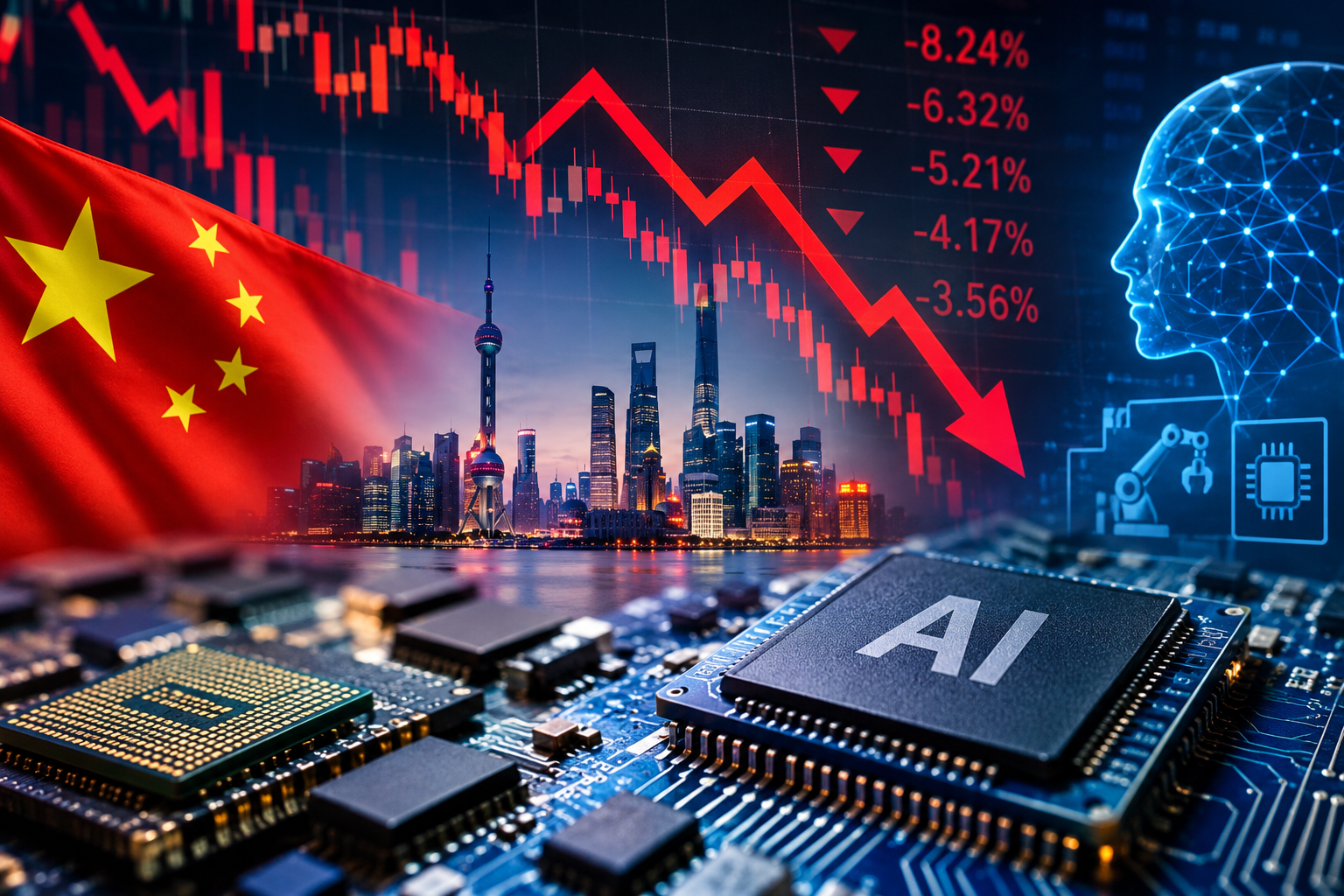
According to a Reuters analysis published on October 26, 2026, China’s technology-focused STAR 50 Index fell approximately 40% in less than four months, wiping out around $480 billion in market value. The broader CSI 300 Index also declined approximately 20% from its June peak. The downturn followed a strong rally in Chinese technology shares driven by enthusiasm for AI, robotics and domestic semiconductor development. Source: Reuters.
The correction highlights a growing challenge for China’s technology industry: turning rapid technological development into sustainable business growth and consistent financial returns.
Why Are China’s AI and Semiconductor Stocks Falling?
Several factors have contributed to the decline in Chinese technology shares. These include high stock valuations, concerns about future AI demand, international trade restrictions and uncertainty surrounding company earnings.
Although AI remains an important area of technological development, investors are becoming more selective about which companies can generate sustainable profits from the growing market.
1. High Valuations Increase Market Pressure
One of the main reasons behind the sell-off is the high valuation of many Chinese AI and semiconductor companies.
During the earlier rally, investors purchased shares in businesses involved in chip manufacturing, AI infrastructure, robotics and data-centre equipment. Expectations of strong future growth helped push several technology stocks to extraordinary levels.
However, stock prices can become vulnerable when they rise faster than company earnings. Investors may begin selling when they believe that future growth has already been reflected in share prices.
Reuters reported that the STAR 50 Index was trading at approximately 100 times trailing earnings after the correction, compared with a peak of nearly 250 times. This remained a high valuation relative to the Nasdaq 100, which was trading at approximately 30 times earnings in the same report.
These figures suggest that investors may still be paying a substantial premium for expected growth in China’s technology sector.
The recent decline demonstrates why business performance, earnings and realistic growth expectations matter alongside technological innovation.
2. Uncertainty Surrounding AI Demand
Artificial intelligence has attracted significant investment from technology companies, financial institutions and governments worldwide. Businesses are spending on AI models, cloud computing, data centres, specialised processors and advanced networking equipment.
However, investment in AI infrastructure does not automatically guarantee strong returns for every company involved.
Technology developers must find customers willing to pay for their products while managing research, development, computing and operating costs. Companies may also face intense competition as new AI models and services enter the market.
For Chinese AI businesses, the challenge is to demonstrate that their technology can attract users, generate recurring revenue and maintain competitive profit margins.
Investors are increasingly examining whether AI-related companies can turn rising adoption into measurable financial performance. Businesses that cannot meet expectations may face additional pressure on their share prices.
Importantly, declining stock prices do not necessarily mean that demand for AI has disappeared. Instead, the market correction reflects concerns about valuations and the financial returns expected from the sector.
3. Semiconductor Companies Face Growing Competition
China’s semiconductor industry is another important part of the current market story.
Semiconductors are essential for AI servers, smartphones, electric vehicles, industrial equipment and modern computing systems. As demand for AI computing increases, chip manufacturers have opportunities to expand production and develop new technologies.
However, the industry requires substantial capital investment, specialised engineering skills and continuous research and development.
Chinese semiconductor companies must also compete on manufacturing efficiency, product performance, reliability and price. If several manufacturers expand production at the same time, competition can intensify and reduce profit margins.
Reuters reported that Chinese chipmakers MetaX Integrated Circuits and Moore Threads Technology experienced substantial declines after strong gains following their market debuts. Memory-chip company CXMT also came under pressure during the correction.
These developments indicate that investor enthusiasm for domestic semiconductor production does not remove the commercial risks facing individual companies.
For the industry to grow sustainably, manufacturers will need to balance technological progress with production costs, customer demand and long-term profitability.
4. Export Restrictions Create Additional Uncertainty
International trade policies represent another potential challenge for Chinese technology businesses.
Companies producing chips, optical components and data-centre equipment may depend on overseas customers and international supply chains. Restrictions on technology exports or access to particular markets can affect their potential revenue.
Reuters reported that shares in optical-component manufacturers Zhongji Innolight and Eoptolink Technology fell approximately 60% from their respective highs in June and July. Concerns about possible US restrictions on supplying equipment to data centres were among the factors affecting sentiment.
Optical components help transfer data between servers and other computing equipment, making them important for modern AI infrastructure.
If companies face restrictions in overseas markets, they may need to find new customers, adjust their supply chains or concentrate more heavily on domestic demand. These changes can take time and may increase operating costs.
At the same time, trade restrictions can encourage Chinese businesses to develop domestic alternatives and invest in local technological capabilities. The long-term commercial impact will depend on how effectively companies adapt to changing market conditions.
5. Retail Investors Face Greater Financial Risks
The stock market correction has also affected individual investors who purchased technology shares during the earlier rally.
AI-related stocks accounted for approximately 42% of China’s stock market capitalisation and 57% of trading turnover across mainland-listed A-shares and Hong Kong-listed H-shares, according to Goldman Sachs data cited by Reuters.
This concentration meant that changes in investor sentiment toward AI and semiconductor companies had significant implications for market activity.
Some investors had expected shares associated with China’s technology ambitions to continue rising. However, government support for an industry does not guarantee that every company will achieve its financial targets or that its stock price will remain high.
Sharp declines can affect investor confidence and make people more cautious about future technology investments.
The correction could also influence fundraising by companies planning to list their shares or attract additional capital. If investors become more selective, businesses may face greater scrutiny over their earnings, valuations and commercial prospects.
For individual investors, the situation reinforces the importance of understanding financial risks rather than relying solely on the popularity of a particular technology trend.
What Does the Market Correction Mean for China’s AI Industry?
The decline in technology stocks does not necessarily mean that China’s AI industry is failing. Stock market performance and technological progress are related, but they are not the same thing.
Companies can continue developing advanced AI models, semiconductor products and robotics systems even when their shares decline.
However, the correction may encourage businesses to focus more closely on commercial results. Investors may increasingly favour companies that can demonstrate sustainable revenue, effective cost management and a clear path to profitability.
AI developers will need to show that their products provide practical value to customers. Semiconductor manufacturers will need to demonstrate that their production capabilities can compete on price, performance and reliability.
Businesses with strong finances and established customer relationships may be better positioned to manage a period of weaker investor confidence. Companies that rely heavily on external funding could face greater challenges if fundraising becomes more difficult.
The market may therefore place greater emphasis on individual company performance rather than treating AI and semiconductor businesses as a single investment category.
Could Chinese Technology Stocks Recover?
The timing and extent of any recovery remain uncertain. Future market performance will depend on company earnings, AI demand, competition, international trade policies and broader economic conditions.
Several developments could help improve investor confidence:
- Stronger company earnings: Consistent revenue and profit growth could help justify technology valuations.
- Commercial AI adoption: Businesses that successfully turn AI products into revenue-generating services may attract greater investor interest.
- Competitive semiconductor products: Improvements in chip performance, manufacturing efficiency and production costs could support long-term growth.
- Clearer trade policies: Greater certainty around access to international markets could help companies plan investments and business expansion.
- More realistic valuations: A market adjustment may allow investors to assess companies according to their financial performance and long-term prospects.
Nevertheless, these factors do not guarantee a recovery. Further declines remain possible if earnings disappoint, competition intensifies or international restrictions affect business opportunities.
Investors will need to distinguish between companies with strong commercial foundations and businesses whose valuations depend primarily on expectations of rapid future growth.
Conclusion
China’s AI and semiconductor stocks are facing significant market pressure after a period of strong investor enthusiasm. The approximately $480 billion reduction in market value reported in October 2026 highlights the risks associated with high valuations, uncertain demand and changing international trade conditions.
The correction also demonstrates that technological innovation alone cannot guarantee financial success. AI developers, chip manufacturers and technology suppliers must build commercially sustainable businesses while managing competition, operating costs and market uncertainty.
Despite the downturn, artificial intelligence and semiconductor development remain important areas of technological investment. The key question is whether companies can convert that investment into consistent earnings and long-term commercial growth.
For businesses and investors, the latest market developments provide an important reminder: the future of AI may remain significant, but individual companies must still prove the strength of their business models.
Frequently Asked Questions
Why are China’s AI stocks falling?
Chinese AI stocks have declined amid concerns about high valuations, future AI demand, company profitability and possible restrictions on technology exports.
How much market value has been lost?
Reuters reported on October 26, 2026, that China’s STAR 50 Index had fallen approximately 40% in less than four months, erasing around $480 billion in market value.
Are semiconductor companies affected by the downturn?
Yes. Several Chinese semiconductor and technology companies have experienced substantial share-price declines as investors reassess their valuations, earnings prospects and exposure to international markets.
Does the decline mean China’s AI industry is failing?
No. A stock market correction does not necessarily indicate that an industry is failing. It may reflect changing investor expectations, high valuations or uncertainty about future profits.
What could help China’s AI stocks recover?
Stronger earnings, sustainable AI demand, competitive semiconductor products and greater clarity around trade policies could support investor confidence. However, a recovery is not guaranteed.