What Is a Lastenheft (vs. Pflichtenheft)? A UK Software & Business Guide
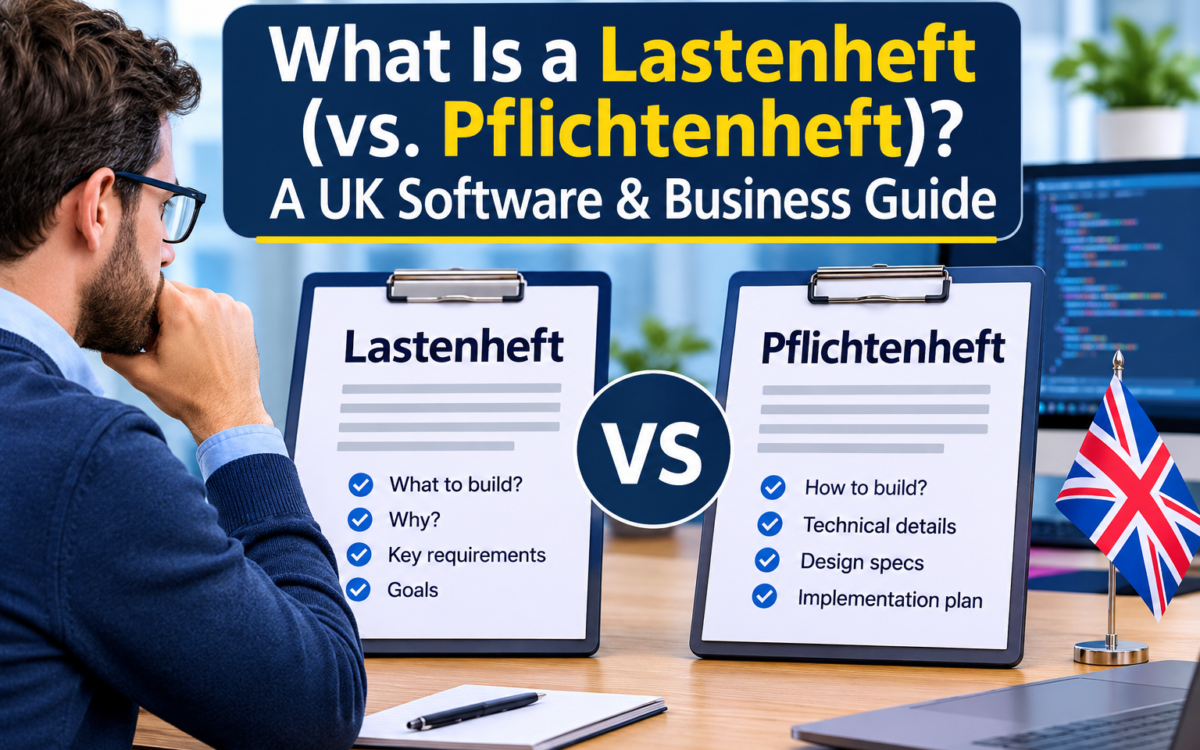
Quick Answer: A Lastenheft (User Requirement Specification) is a formal German project document written by the client that defines what software, system, or product needs to be built and why it is needed. By contrast, a Pflichtenheft (Functional Specification) is written by the contractor or software agency to explain how they will technically build and deliver that solution. For UK software agencies, IT freelancers, and tech founders working with European clients, understanding both documents is essential for preventing scope creep, protecting intellectual property, and winning cross-border contracts.
Introduction: Why UK Tech & Software Teams Are Searching for “Lastenheft”
If you run a UK software development agency, work as an independent IT consultant, or manage product procurement for a British company, you will eventually encounter European tender documents or client briefs containing the words Lastenheft and Pflichtenheft.
Because Germany, Austria, and Switzerland (the DACH region) represent Europe’s largest enterprise software and industrial engineering market, British tech firms routinely bid on contracts or collaborate with European partners who rely on strict German project governance standards (such as DIN 69901). However, searching for “Lastenheft” online often leads to overly academic German translations or dry engineering definitions that ignore what UK business owners actually need to know.
In practical UK business terms, a Lastenheft is the European equivalent of a Business Requirements Document (BRD) or Statement of Requirements, while a Pflichtenheft acts as the legally binding Functional Specification Document (FSD) or Statement of Work (SOW).
Whether you are scaling a digital agency—building on the foundations covered in our guide on how to start a business in the UK as a sole trader—or drafting procurement rules for your internal tech stack, mastering these two documents will save your team from costly contract disputes and endless unpaid revisions.
Lastenheft vs. Pflichtenheft: The Core Difference Explained
In German-speaking business culture, software development, IT infrastructure upgrades, and custom engineering projects follow a strict two-stage handover process before a single line of code is written.
What Is a Lastenheft? (The Client’s “What & Why”)
- Literal Translation: Last (load/burden/requirement) + Heft (booklet/document).
- English Equivalent: User Requirement Specification (URS) or Business Requirements Document (BRD).
- Who Writes It: The client (or internal product owner) commissioning the project.
- Core Purpose: It defines the business problem, target users, desired outcomes, budget boundaries, and mandatory compliance rules from the customer’s perspective—without dictating the underlying programming language or server architecture.
What Is a Pflichtenheft? (The Vendor’s “How & When”)
- Literal Translation: Pflicht (duty/obligation) + Heft (booklet/document).
- English Equivalent: Functional Specification Document (FSD) or Technical Statement of Work (SOW).
- Who Writes It: The contractor, software agency, or IT vendor executing the project.
- Core Purpose: After reviewing the client’s Lastenheft, the vendor writes the Pflichtenheft to detail the exact technical architecture, API integrations, milestone timelines, testing criteria, and deliverables they are legally committing to build. Once signed by both parties, the Pflichtenheft becomes the binding contract benchmark.
Side-by-Side Comparison: Lastenheft vs. Pflichtenheft
| Feature / Dimension | Lastenheft (Client Brief) | Pflichtenheft (Vendor Blueprint) |
| English Equivalent | User Requirement Specification (URS) / BRD | Functional Specification (FSD) / Statement of Work |
| Author / Owner | The Client (Buyer / Product Owner) | The Contractor (UK Software Agency / Freelancer) |
| Core Question Answered | What do we need, and why do we need it? | How will we build it, and when will it be delivered? |
| Project Stage | Pre-tender / Request for Proposal (RFP) phase | Post-award / Pre-development contract sign-off |
| Technical Depth | High-level business goals, user stories, and constraints | Detailed database schemas, UI wireframes, APIs, and SLAs |
| Legal Status | Invitation to tender / Baseline expectations | Legally binding delivery specification once approved |
-
What Goes Inside a Standard Lastenheft? (8 Essential Sections)
When a UK software company receives a Lastenheft from a European enterprise—or writes one internally to hire external developers—it typically follows a structured eight-part framework aligned with German project management standards:
- Project Overview & Background (Ausgangssituation): Explains the client’s current business setup, legacy software bottlenecks, and why the new system is being commissioned.
- Project Goals (Zielsetzung): Defines measurable business KPIs (for example, reducing invoice processing time by 40% or supporting 50,000 concurrent mobile users).
- Target Audience & User Roles (Zielgruppe): Identifies who will use the software (internal staff, B2B buyers, or public customers) along with permission levels.
- Functional Requirements (Funktionale Anforderungen): Lists the specific features required, often categorized using the MoSCoW method (Must-have, Should-have, Could-have, Won’t-have).
- Non-Functional Requirements (Nicht-funktionale Anforderungen): Covers system uptime SLAs (e.g., 99.9% availability), page load speeds, cybersecurity encryption, and GDPR data residency rules.
- System Environment & Integrations (Systemumgebung): Specifies existing ERP, CRM, or HMRC-approved accounting software platforms that the new tool must connect with via REST APIs or webhooks.
- Deliverables & Documentation (Lieferumfang): Clarifies whether the vendor must provide source code repositories, admin training, user manuals, and post-launch maintenance.
- Timeline & Budget Constraints (Zeitplan & Budget): Sets target launch dates, pilot testing phases, and commercial pricing expectations.
- What Competitors Miss: UK Legal, AI & Agile Pitfalls to Watch Out For
Most basic definitions online stop after translating the two words. However, if you operate a UK tech business, software agency, or consultancy, jumping straight into a German Lastenheft without adapting it to British commercial practices can create serious legal and operational risks.
UK Intellectual Property (IP) Ownership Rules Differ from Germany
Under UK copyright law (the Copyright, Designs and Patents Act 1988), if a UK business hires an external freelance developer or software agency to build custom code, the contractor automatically owns the intellectual property unless a written contract explicitly assigns IP to the client.
- Action Step: Never rely solely on a translated Lastenheft to transfer code ownership. Ensure your Pflichtenheft or Master Services Agreement (MSA) includes an explicit UK IP assignment clause—a point emphasized in our guide on when to hire a business lawyer in the UK.
-
Using AI Tools Safely to Translate & Draft Specifications
Many UK founders now use generative AI tools like ChatGPT or Claude to translate a 40-page German Lastenheft into English or to generate a first draft of a Pflichtenheft. While AI speeds up technical scoping, pasting confidential client architecture, proprietary API keys, or unreleased product roadmaps into public AI models creates major data-leak and NDA breaches.
- Action Step: Before uploading client specifications into any LLM, anonymize sensitive company names and enforce strict workplace rules—following the governance steps outlined in our AI policy for UK small businesses and our guide on how to use AI tools at work without leaking company data.
-
Bridging Waterfall Specifications with Agile Sprints
Traditionally, the Lastenheft / Pflichtenheft model comes from structured “Waterfall” engineering, where every feature is locked down upfront. Most modern UK software teams, however, build using Agile Scrum or Kanban sprints.
- Action Step: If a European client insists on a formal Pflichtenheft, structure it around Agile milestones. Define the core Minimum Viable Product (MVP) architecture and fixed-price discovery sprint in the Pflichtenheft, while leaving UI refinements and secondary feature priorities flexible through bi-weekly sprint sign-offs.
-
UK GDPR & Cross-Border Data Compliance
When a UK software vendor processes personal data for an EU client under a Pflichtenheft, both UK GDPR and EU GDPR apply.
- Action Step: Include a dedicated Data Processing Addendum (DPA) inside your Pflichtenheft specifying where cloud servers are hosted (e.g., AWS London vs. AWS Frankfurt) and confirming compliance with the UK-EU data adequacy framework.
-
How UK Businesses Can Write a Clear Requirements Brief (4-Step Template)
Even if you never work with a German client, adopting the Lastenheft mindset internally will dramatically reduce software development overspends when hiring UK agencies or offshore developers:
- Separate Problems from Solutions: In your initial brief (Lastenheft), describe the business bottleneck clearly (e.g., “Our sales team spends 6 hours a week manually reconciling Stripe payouts”), rather than forcing developers to use a specific plugin that might break later.
- Require a Written Technical Response (Pflichtenheft): Before paying a deposit to any software agency, require them to write back a detailed specification confirming every integration, edge case, hosting cost, and acceptance test.
- Define “Done” with Acceptance Criteria: Specify exactly how each feature will be tested before final milestone payments are released (User Acceptance Testing / UAT).
- Budget for Post-Launch Maintenance: Ensure the Pflichtenheft clearly separates one-off build costs from ongoing monthly hosting, security patches, and API maintenance fees.
(Explore more practical guides on choosing business applications, digital workflows, and enterprise platforms across our Software and Technology & AI sections.)
Frequently Asked Questions (FAQs)
What does “Lastenheft” mean in English?
Lastenheft is a German project management term meaning User Requirement Specification (URS) or Business Requirements Document (BRD). It is written by the client to explain what software or product they need and why they need it.
What is the main difference between a Lastenheft and a Pflichtenheft?
The Lastenheft is written by the client and describes the business requirements and desired outcomes (the “what”). The Pflichtenheft is written by the contractor or software agency and details the exact technical implementation, architecture, and delivery schedule (the “how”).
Do UK companies need a Lastenheft when hiring a software developer?
While UK companies usually call this document a Requirements Brief, PRD (Product Requirements Document), or Statement of Work (SOW), using the structured Lastenheft format is highly recommended—especially when bidding on European contracts or managing complex, fixed-price software builds.
Is a Lastenheft legally binding?
No. A Lastenheft is typically an invitation to tender or a baseline requirements brief. Once the vendor responds with a detailed Pflichtenheft and both parties sign off on it, the Pflichtenheft becomes the legally binding technical specification for the contract.
Can I use ChatGPT to translate a German Lastenheft into English?
Yes, AI tools are effective for translating technical German terminology, but you must remove confidential client names, pricing data, and proprietary system details first—or use an enterprise AI workspace with zero data retention—to avoid breaching Non-Disclosure Agreements (NDAs) and UK GDPR rules.
Summary Checklist for UK Founders & Software Teams
- Know Your Document Role: Treat a Lastenheft as the client’s wish list (What & Why) and the Pflichtenheft as your agency’s binding technical blueprint (How & When).
- Protect UK IP Rights: Always pair a technical specification with a formal UK contract assigning intellectual property upon final payment.
- Lock In Scope Early: Use a MoSCoW priority table inside your Pflichtenheft so extra client requests are billed as formal change requests rather than unpaid scope creep.
- Keep AI Translations Secure: Strip sensitive client data before using generative AI tools to translate or summarize cross-border tender documents.