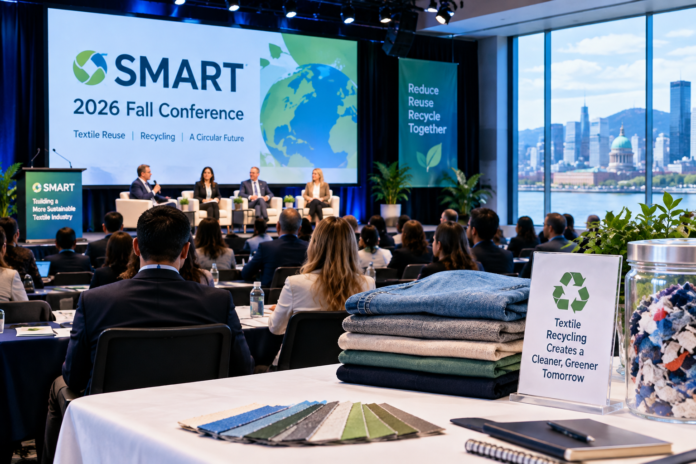
The SMART 2026 Fall Conference is scheduled to bring together professionals from the textile reuse and recycling industry in Montreal, Canada, from October 20 to October 22, 2026. The event will focus on textile recovery, second-hand clothing, recycling technologies, business innovation, artificial intelligence, and policies affecting the international textile trade.
Organized by the Secondary Materials and Recycled Textiles Association (SMART), the conference provides a platform for industry leaders, manufacturers, exporters, recyclers, and other professionals to discuss challenges and opportunities in the circular textile economy.
The event will take place at the Marriott Montréal Château Champlain in Montreal, Quebec. Its published program includes keynote presentations, industry panels, networking sessions, and discussions about the future of textile reuse and recycling.
What Is the SMART 2026 Fall Conference?
The SMART 2026 Fall Conference is an industry-focused gathering for businesses and professionals working with used clothing, textile recovery, wiping materials, and recycled fibres.
Unlike a conventional fashion week, the conference does not primarily showcase new clothing collections on a runway. Instead, it focuses on the systems and businesses that collect, sort, reuse, process, and recycle textile materials.
These activities are important because discarded clothing and other textiles can retain value when they are suitable for reuse or recycling. Effective recovery systems can help businesses find new uses for materials while reducing the amount of usable textiles sent to landfill.
The conference is designed to help participants exchange knowledge, understand regulatory developments, explore new technologies, and build professional relationships.
When and Where Will the Conference Take Place?
The SMART 2026 Fall Conference is scheduled for October 20–22, 2026.
The venue is the Marriott Montréal Château Champlain, located in Montreal, Quebec, Canada. Montreal is a major Canadian city with an international business community and a well-established conference and hospitality sector.
The event begins on October 20 with registration, a new-member reception, and an opening reception. The main conference sessions take place on October 21 and October 22.
Professionals planning to attend should consult the official event website for registration requirements, travel arrangements, ticket prices, and any schedule updates.
Who Organizes SMART 2026?
The event is organized by the Secondary Materials and Recycled Textiles Association, commonly known as SMART.
The association describes itself as an international trade organization representing the wiping materials, used clothing, and fibre industries. Its work includes education, networking, advocacy, and supporting economic opportunities in textile reuse and recycling.
SMART was established in 1932. Its activities reflect the long-standing commercial importance of recovering and reusing textile materials.
The organization brings together businesses operating in different parts of the supply chain, including collection, sorting, processing, exporting, and recycling. This broad industry perspective helps make the conference relevant to both established businesses and companies exploring new approaches to textile recovery.
Which Speakers Will Participate?
The published conference program identifies several speakers who will address important developments in the textile reuse and recycling industry.
Oliver Ardery: Artificial Intelligence and Business Automation
Oliver Ardery, CEO of Applied Industrials, is scheduled to deliver the keynote presentation on October 21.
His session, titled SMART AI Adoption: Front- and Back-Office Automation, will examine how textile recyclers, processors, and exporters can use artificial intelligence to improve business operations.
Potential applications include automating customer service responses, matching invoices, managing order entry, and improving administrative workflows.
For textile businesses handling large volumes of materials and transactions, automation may help reduce repetitive work and improve operational efficiency. The session is expected to focus on practical implementation rather than AI as an abstract concept.
Chris McLellan: Data Collaboration
Chris McLellan is scheduled to present a session titled Closing the Data Gap: The Case for Data Collaboration in the Age of AI and EPR.
His presentation will explore how fragmented industry information can make it difficult for independent textile businesses to demonstrate their economic and environmental contributions.
Better data collaboration could help businesses present more complete evidence about material recovery, reuse, and recycling activities. Such information may also help industry representatives participate more effectively in policy discussions.
The session is particularly relevant as governments and regulators consider producer-responsibility requirements and international rules affecting recovered materials.
Jennifer Wang: The International Trade in Used Textiles
Jennifer Wang of Full Cycle Resource Consulting is scheduled to speak on October 22.
Her presentation, Evidence Before Classification: What the Data Tells Us About Used Textiles, will examine how decisions about classifying used textiles could affect international trade.
The discussion will consider different parts of the supply chain, including collectors, sorters, exporters, importers, wholesalers, recyclers, and waste-management operators.
Changes in classification rules or cross-border movement requirements could affect trading costs, market access, and the handling of materials intended for reuse or recycling.
The presentation will also highlight the importance of involving industry participants in policy discussions so that decisions reflect evidence from real supply-chain operations.
Other Industry Contributors
The published schedule also includes a legislative update by Jessica Franken, along with panels covering collections, used clothing, and wiping materials.
SMART President Brian London is scheduled to deliver the conference welcome on October 21.
These sessions are intended to provide a broader view of the operational, commercial, and regulatory issues affecting textile reuse businesses.
Which Companies Are Listed as Attendees?
The official attendee list includes businesses operating across the used-clothing and textile-recycling supply chain.
Examples include Bank & Vogue Limited, Boer Group, Garson & Shaw, Savers Value Village, ThredUp, Reju, AL-BASIT Textiles, J and K Textile International Private Limited, Mohib Exports, and Retex Global.
The range of listed organizations illustrates the international reach of the industry, spanning material recovery, used-clothing trading, recycling, resale, and related services.
However, the published attendee list should be treated as an indication of registered or listed participation rather than confirmation that every company will send representatives.
For businesses looking to establish partnerships, the conference provides opportunities to connect with other participants and learn about developments across the textile supply chain.
What Topics Will the Conference Cover?
Textile Reuse and Recycling
A central theme is how used clothing and textile materials can be recovered and directed toward suitable second-life applications.
This includes improving collection and sorting, identifying reusable materials, and finding appropriate recycling routes for textiles that cannot be resold in their original form.
Artificial Intelligence in Textile Businesses
AI and automation are becoming relevant to business administration, customer service, data processing, and other operational tasks.
The conference keynote will consider how these tools may help textile companies streamline workflows and improve productivity.
International Trade and Regulation
Used textiles move through international supply chains. Their treatment under customs, environmental, and waste-management rules can affect businesses in both exporting and importing countries.
Conference discussions will examine the implications of possible regulatory changes and the importance of industry evidence in policy development.
Data, Transparency, and Sustainability
Reliable information about collection, reuse, recycling, and material flows can help businesses demonstrate their contribution to the circular economy.
Improved reporting and collaboration may also help policymakers understand the industry’s operations and evaluate potential regulatory changes.
Why Is the SMART Conference Important?
Textile reuse and recycling involve a complex network of businesses, from local collection services to international exporters and recycling facilities.
Changes in consumer behavior, material quality, transportation costs, technology, and regulation can affect the entire supply chain.
An industry conference such as SMART 2026 provides a place for professionals to discuss these challenges, share practical experience, and identify potential opportunities for collaboration.
It also highlights the relationship between environmental objectives and commercial realities. Recovering textiles effectively requires systems that are both environmentally responsible and economically workable.
By bringing together participants from different parts of the industry, the event can help encourage more informed discussions about the future of textile recovery.
How to Follow the SMART 2026 Fall Conference
Readers can find the official event schedule, speaker biographies, attendee information, and registration details on the SMART website.
Official conference website: https://www.smartasn.org/events/montreal-conference/
The organizer’s schedule should be checked for the latest session times because conference programs can change as arrangements are finalized.
People who cannot attend in person can follow SMART’s website and professional social media channels for event updates and future announcements.
Conclusion
The SMART 2026 Fall Conference will take place in Montreal, Canada, from October 20 to October 22. Organized by the Secondary Materials and Recycled Textiles Association, the event brings together professionals working in textile reuse, recycling, and related industries.
Its published program covers artificial intelligence, data collaboration, used-textile classification, international trade, and industry regulation. Confirmed speakers include Oliver Ardery, Chris McLellan, and Jennifer Wang, alongside sessions involving SMART leadership and industry representatives.
For businesses interested in textile recovery, circular-economy practices, and the international used-clothing market, the conference offers a valuable opportunity to learn about industry developments and connect with professionals working across the supply chain.
Frequently Asked Questions
When is the SMART 2026 Fall Conference?
The conference is scheduled for October 20–22, 2026.
Where will the SMART conference take place?
It will be held at the Marriott Montréal Château Champlain in Montreal, Quebec, Canada.
Who organizes the SMART conference?
The event is organized by the Secondary Materials and Recycled Textiles Association (SMART), an international trade association established in 1932.
Who are the confirmed speakers?
The published speaker list includes Oliver Ardery, Chris McLellan, and Jennifer Wang. The program also identifies SMART President Brian London and a legislative update by Jessica Franken.
Is SMART 2026 a fashion show?
No. It is an industry conference focused on textile reuse, recycling, second-hand clothing, business innovation, and related regulations rather than a conventional runway show.
What will participants discuss?
Topics include artificial intelligence, data collaboration, textile recycling, international trade, legislation, and the circular economy.

