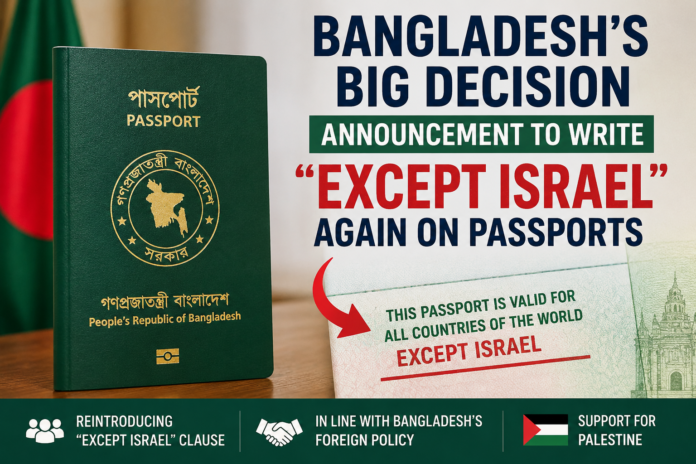
Bangladesh has announced the reintroduction of the phrase “Except Israel” on its general passports, marking a significant return to a long-standing policy position. The decision reflects the country’s traditional diplomatic stance and widespread public sentiment regarding the Palestinian issue.
According to official statements reported from Dhaka, Home Minister Salahuddin Ahmed confirmed that the phrase “This passport is valid for all countries of the world except Israel” will again be included in newly issued passports. He noted that implementation has already begun in diplomatic passports and will now be extended to general passports.
Government sources within the Ministry of Home Affairs and the Immigration and Passport Department stated that the move aligns with Bangladesh’s principled foreign policy position in support of Palestine. Officials also emphasized that Bangladesh does not maintain diplomatic relations with Israel, a stance that has remained unchanged since the country’s independence in 1971.
The phrase “Except Israel” was previously removed in 2021 during the introduction of e-passports under the government led by Sheikh Hasina. That change had drawn criticism from several political groups and sections of the public, who viewed it as a departure from Bangladesh’s historical position. The latest decision, therefore, is being seen by observers as a restoration of earlier policy rather than a new diplomatic direction.
Reports suggest that the decision to reinstate the wording was also influenced by an earlier directive issued during the interim government last year, when the Ministry of Home Affairs had instructed relevant departments to restore the clause. However, full implementation was delayed until the current announcement.
In addition to the passport wording change, authorities are also reportedly revising design elements of new passports. This includes updates to watermark features and official imagery. Some symbolic images are expected to be replaced, including references associated with national history, while others will be introduced to reflect contemporary movements. Among those mentioned is Abu Saeed, who has been described in local media as a figure linked to recent youth-led movements.
Historically, Bangladesh has maintained a consistent position of non-recognition of Israel, and the passport restriction has been one of the clearest expressions of that policy. Officials argue that the updated passport format reaffirms the country’s diplomatic principles while aligning official documentation with public sentiment.
The decision is expected to generate discussion both domestically and internationally, particularly among diplomatic observers tracking South Asia’s foreign policy alignments. However, Bangladeshi authorities have reiterated that the move does not represent any change in international obligations but rather a continuation of established national policy.
FAQ
1. Why did Bangladesh reintroduce “Except Israel” on passports?
The government says it reflects its traditional foreign policy and public support for Palestine.
2. Does Bangladesh have diplomatic relations with Israel?
No, Bangladesh does not maintain diplomatic relations with Israel.
3. When was the phrase removed from passports?
It was removed in 2021 during the introduction of e-passports.
4. Who announced the decision?
Home Minister Salahuddin Ahmed announced the policy change.
5. Will all passports be updated?
Yes, the change is expected to be applied to both general and diplomatic passports.
6. Is this a new foreign policy toward Israel?
No, officials say it is a continuation of Bangladesh’s long-standing position.

