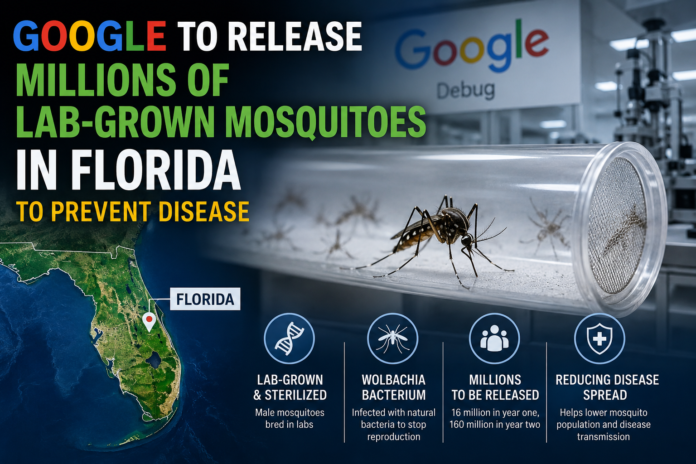
Google is preparing to launch an ambitious biotechnology experiment in the United States that could reshape how mosquito-borne diseases are controlled. Through its experimental program known as “Debug,” the company plans to release millions of laboratory-grown mosquitoes in Florida as part of a large-scale public health initiative.
The project, developed under Google’s parent company Google, aims to reduce the spread of diseases such as dengue, Zika, and malaria by using genetically and biologically modified insects to disrupt mosquito reproduction cycles.
A Science-Driven Approach to Disease Control
At the core of the initiative is the use of bacteria-infected and sterilised male mosquitoes. These insects are bred in controlled laboratory environments and then released into the wild, where they mate with female mosquitoes. The result is a significant reduction in the population of disease-carrying mosquitoes over time.
According to project details, Google’s Debug team is using a combination of artificial intelligence, robotics, and biological engineering to scale mosquito production. The company has reportedly developed specialised insect-rearing systems capable of producing millions of mosquitoes efficiently, something that has previously been difficult due to the fragile nature of these insects.
The program is also working with a strain of the Wolbachia bacterium, a naturally occurring microorganism that interferes with mosquito reproduction. When male mosquitoes infected with Wolbachia mate with wild females, the resulting eggs do not hatch, gradually reducing the overall mosquito population.
Large-Scale Release Planned in the US
In its first phase, the experiment will involve the release of approximately 16 million sterilised male mosquitoes across selected areas in Florida and California. In the second year, the number could increase dramatically to around 160 million mosquitoes.
However, officials have not yet disclosed the exact cities where the trials will take place or the specific timeline for deployment. The proposal was filed through an experimental use permit submitted to the Federal Register, allowing limited field testing under regulatory oversight.
Expert Reactions and Concerns
While the idea of releasing billions of modified mosquitoes may sound alarming, many experts in vector control are not surprised. Similar techniques have been tested on a smaller scale in various countries with promising results.
Public health researchers suggest that such biological control methods could reduce reliance on chemical insecticides, which often harm other ecosystems and lead to pesticide resistance.
Still, some environmental scientists are calling for caution. They stress the importance of long-term monitoring to ensure that altering mosquito populations does not unintentionally disrupt local ecosystems.
A New Frontier in Public Health
If successful, Google’s Debug initiative could mark a major breakthrough in the fight against mosquito-borne illnesses. By combining biotechnology with artificial intelligence, the project represents a new frontier in disease prevention—one where software engineering and biology intersect to solve global health challenges.

