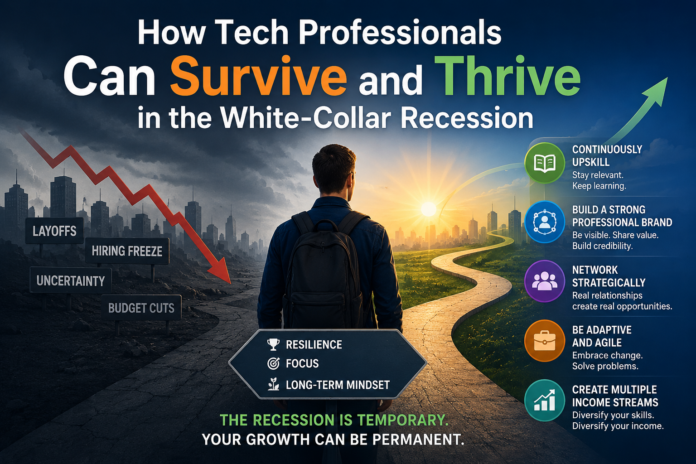
For the past 50 years, the tech sector has been one of the strongest engines of economic and social mobility in America — the cornerstone of the modern knowledge-worker dream.
Yet for nearly a year, the white-collar recession has hit hard. Major companies continue to announce sweeping layoffs, hiring has slowed dramatically, and even in the Bay Area, white-collar job numbers have plummeted.
In this challenging environment, how can tech professionals not only survive but position themselves for long-term success?
Key Strategies to Navigate the Downturn
- Protect and strengthen your current role
- Actively search for new opportunities — starting now
- Build and leverage a strong referral network
- Master AI instead of competing against it
- Continuously develop high-value, hard-to-automate skills
1. Try to Keep Your Current Job
This may sound obvious, but staying employed is one of the biggest advantages you have right now. Hiring managers have grown increasingly skeptical of candidates who are unemployed, even in a tough market. Many privately admit they assume “something must be wrong” with someone out of work, making it far easier to get your next role while you still have one.
There are some positive signals on the horizon. The reversal of certain R&D amortization rules under the One Big Beautiful Bill Act is expected to encourage companies to bring more engineering and research roles back to the U.S. Combined with the Federal Reserve’s recent rate cuts, these changes could gradually improve the job market through 2026 — assuming no deeper recession takes hold.
Action steps:
- Document your achievements, projects, and business impact in detail.
- Review your contributions quarterly against company and team goals.
- Build strong internal relationships across functions and levels.
2. Start Looking for a New Job — Today
The era of lifelong loyalty to one company is over. In today’s market, the most reliable way to increase your salary and advance your career is to change companies every few years.
Treat job searching as a continuous, part-time activity. Keep a detailed journal of your accomplishments, challenges overcome, people managed, and measurable impact. This record becomes invaluable when updating your resume or preparing for interviews.
Use your current position to expand your network. Schedule one-on-ones with people across the organization. Focus on building genuine, mutually beneficial relationships. Keep conversations constructive, light, and action-oriented rather than turning into complaint sessions.
3. Referrals Are Now the Only Reliable Path
AI-powered resume tailoring and interview tools have flooded recruiters with applications. Many job posts now receive hundreds of submissions within hours. In response, companies rely heavily on referrals.
Industry estimates suggest 60–80% of knowledge worker hires now come through referrals. A strong recommendation from someone trusted inside the company dramatically increases your chances of getting noticed and hired.
How to build an effective network:
- Offer help before asking for it — be a giver.
- Maintain meaningful contact beyond generic LinkedIn likes or comments.
- Send relevant articles, celebrate wins, and occasionally email their manager when they help you.
- Stay in touch with former colleagues on good terms.
Your professional reputation as someone reliable, helpful, and competent is just as important as your technical skills.
4. Know Thy Enemy: Embrace AI
If you’re not actively using and discussing AI in your role, you risk being seen as someone who isn’t adapting. Companies are investing billions to automate white-collar work. Your best defense is to become the person who understands AI’s strengths and limitations.
Practical approach:
- Track which parts of your job AI handles well and where it fails.
- Identify tasks that require human judgment, office politics, institutional knowledge, or nuanced decision-making.
- Discuss AI openly with your team and leadership.
- Automate repetitive work while volunteering for responsibilities that are harder to automate.
Position yourself as the bridge between AI tools and real business value.
5. Focus on Skills That Matter — and Can’t Be Easily Automated
Technical skills have a short shelf life (roughly 2–3 years), but you can accelerate learning using AI itself. Use it to quickly master new tools, summarize complex topics, or analyze data.
Prioritize:
- Integrating AI into existing systems (APIs, data pipelines, automation scripts).
- Domain expertise combined with business acumen.
- Leadership, stakeholder management, and cross-functional coordination.
Skip generic certificates unless they carry legal, regulatory, or compliance weight. Instead, build real proof: freelance work, internal projects, or a strong portfolio that demonstrates you can deliver results and speak intelligently about your work.
The Way Forward
We are living through a genuine inflection point. AI is pulling at the seams of what makes experienced tech professionals valuable. Companies chasing profits will continue adopting every tool that cuts costs.
Your job is to use these tools aggressively to stay ahead, while remaining clear-eyed about their limitations. Speak up about ethics, reliability, hidden costs, and long-term risks. Help shape how your organization adopts AI rather than becoming a victim of it.
Survival in this white-collar recession demands resilience, strategic networking, continuous learning, and proactive adaptation. Those who treat this period as a wake-up call — rather than just a hardship — will emerge stronger on the other side.
The tech dream isn’t dead. It’s simply evolving. The professionals who evolve with it will continue to thrive.

