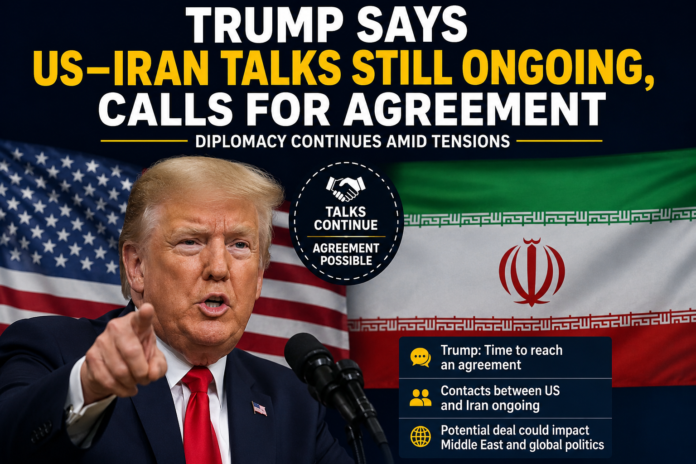
US President Donald Trump has stated that it is time for the United States and Iran to reach some form of agreement, emphasizing that ongoing tensions between the two nations cannot continue indefinitely. In his recent remarks, Trump highlighted that a diplomatic solution remains the most practical and effective path forward amid long-standing political and strategic differences.
According to the President, he has clearly communicated to Iran that the current situation calls for serious negotiations and a structured agreement. He stressed that Iran’s behaviour over the past 47 years has created continuous regional and international challenges, and such patterns, in his view, cannot persist in the future. Instead, he believes that dialogue and diplomacy offer a more stable direction for both countries.
Trump also dismissed reports suggesting that negotiations between Washington and Tehran had stalled. He clarified that communication between the two sides is still ongoing and that discussions have not been interrupted. While he did not provide specific details about the content of these talks, he confirmed that multiple issues are being addressed through diplomatic channels.
He further added that although negotiations are continuing, it is still too early to predict their outcome. According to him, no one can currently determine the direction these discussions will take or what kind of agreement might eventually be reached. However, he reaffirmed that both sides remain in contact, which he sees as a positive sign for potential progress.
The US–Iran relationship has remained tense for decades, largely due to disagreements over Iran’s nuclear programme, regional influence, and international sanctions. In recent weeks, speculation has increased regarding a possible breakthrough or renewed agreement between the two countries. These discussions have drawn global attention, especially from international observers concerned about stability in the Middle East.
Experts suggest that any progress in negotiations could have significant implications not only for US–Iran relations but also for broader geopolitical dynamics, including energy markets, regional security, and global diplomatic alignments. However, the situation remains uncertain, with both sides yet to present any confirmed framework for an agreement.
Trump’s comments reflect a continued focus on diplomatic engagement, even amid longstanding political tensions. While challenges remain, the ongoing communication between Washington and Tehran suggests that dialogue is still active, leaving open the possibility of future developments.
For now, the international community continues to watch closely as both nations navigate complex negotiations that could shape the future of regional and global politics.

