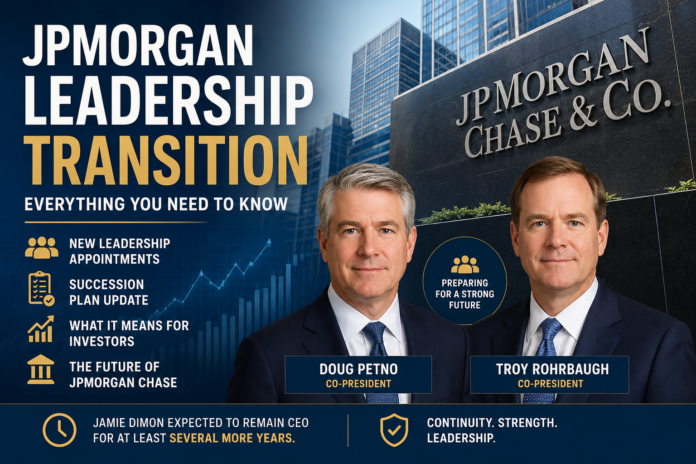
JPMorgan Chase has once again become the center of attention on Wall Street after announcing significant leadership changes that reshape the race to eventually succeed longtime Chief Executive Officer Jamie Dimon. While Dimon is expected to remain CEO for several more years, the bank has taken another important step in preparing for its future leadership.
The announcement has sparked discussions among investors, analysts, and financial experts worldwide. Leadership succession at one of the world’s largest financial institutions is more than just a change in job titles—it can influence investor confidence, corporate strategy, shareholder value, and even the broader banking industry.
This article explains everything you need to know about JPMorgan’s leadership transition, why it matters, who the leading candidates are, and what these changes could mean for the future of the company.
Understanding JPMorgan’s Leadership Transition
Leadership succession is one of the most important responsibilities for any global corporation. Companies worth hundreds of billions of dollars cannot afford uncertainty at the top.
For JPMorgan Chase, succession planning has been an ongoing process for years. Jamie Dimon has led the bank through financial crises, economic recoveries, global pandemics, rising inflation, and technological transformation.
Because of his long tenure and successful leadership, finding the right successor has become one of Wall Street’s biggest questions.
The latest executive reshuffle represents another major milestone in that journey.
Jamie Dimon’s Legacy
Jamie Dimon became CEO of JPMorgan Chase in 2006 and has built the company into one of the strongest financial institutions in the world.
Under his leadership, JPMorgan has:
- Become the largest U.S. bank by assets
- Expanded globally
- Increased shareholder value significantly
- Invested billions in technology
- Strengthened risk management
- Built one of the world’s most profitable banking businesses
His leadership during the 2008 financial crisis earned widespread recognition, helping position JPMorgan as one of the strongest banks during a period of severe financial instability.
Even after nearly two decades as CEO, Dimon remains one of the most influential figures in global finance.
Why Is JPMorgan Preparing for a Leadership Change?
Every major corporation needs a succession plan.
Investors dislike uncertainty.
When a company depends heavily on one executive, markets naturally want to know who will eventually take over.
JPMorgan’s board has therefore spent years developing multiple senior executives capable of assuming the CEO position whenever Dimon decides to step aside.
The latest restructuring is part of that long-term strategy rather than an indication of an immediate leadership change.
The Biggest Leadership Announcements
The company recently announced several important executive changes that have reshaped the succession race.
The key developments include:
- Doug Petno promoted to Co-President
- Troy Rohrbaugh promoted to Co-President
- Jamie Dimon expected to remain CEO for at least several more years
- Senior leadership responsibilities reorganized
- The succession field narrowed significantly
These appointments provide investors with a clearer picture of who could eventually lead the company.
Who Is Doug Petno?
Doug Petno is one of JPMorgan’s most experienced executives.
He has spent more than three decades at the bank, holding leadership positions across commercial banking, investment banking, and corporate finance.
His experience includes:
- Commercial Banking
- Investment Banking
- Corporate Lending
- Energy Sector Advisory
- Client Relationship Management
His broad experience across different banking businesses makes him one of the strongest internal candidates for CEO.
Who Is Troy Rohrbaugh?
Troy Rohrbaugh has also built an impressive career inside JPMorgan.
He began his career in trading before rising through leadership positions within the investment bank.
His strengths include:
- Global Markets
- Securities Services
- Foreign Exchange
- Trading Operations
- Commercial & Investment Banking
His appointment expands his responsibilities considerably, giving him valuable experience across multiple business divisions.
Many analysts believe this broader operational experience strengthens his credentials as a future CEO candidate.
Why These Promotions Matter
Executive promotions at JPMorgan are rarely symbolic.
Instead, they usually represent years of planning.
Future CEOs typically receive broader responsibilities before eventually assuming the top position.
Running multiple business divisions allows executives to demonstrate they can manage:
- Risk
- Revenue growth
- Technology
- Regulation
- Client relationships
- Thousands of employees worldwide
These experiences prepare executives for eventually leading one of the world’s largest financial institutions.
The Importance of Succession Planning
Succession planning is essential for several reasons.
Maintaining Investor Confidence
Investors prefer companies with clear leadership continuity.
Knowing that qualified executives are prepared reduces uncertainty.
Business Continuity
Unexpected leadership changes can disrupt operations.
A succession plan ensures smooth transitions.
Long-Term Growth
Future leaders help shape company strategy years before becoming CEO.
That continuity helps maintain long-term performance.
How the Leadership Structure Has Changed
The latest reshuffle gives both promoted executives greater operational responsibility.
Instead of managing narrower business units, they now oversee larger and more strategically important parts of the company.
This creates a practical leadership test.
The board can evaluate:
- Decision-making
- Crisis management
- Financial performance
- Employee leadership
- Client satisfaction
- Operational efficiency
Their performance over the next few years could influence who eventually becomes CEO.
What Does This Mean for Jamie Dimon?
Despite growing succession discussions, Jamie Dimon is not retiring immediately.
Reports indicate he intends to remain CEO for at least several more years.
That means:
- Leadership continuity remains intact.
- Investors retain confidence in current management.
- The future CEO has additional time to gain experience.
This gradual transition minimizes disruption.
Why Wall Street Is Watching Closely
Leadership transitions at major banks rarely affect only one company.
JPMorgan influences:
- Global banking
- Financial markets
- Investment banking
- Corporate lending
- Consumer banking
- Wealth management
Any future CEO will inherit enormous responsibilities.
That makes today’s leadership decisions highly significant.
How Investors May Benefit
Many investors actually welcome structured succession planning.
It demonstrates that the board is focused on long-term stability rather than reacting to unexpected events.
Positive succession planning often signals:
- Strong corporate governance
- Leadership continuity
- Strategic planning
- Lower operational risk
These factors can improve long-term shareholder confidence.
Technology Will Shape the Next CEO’s Success
Whoever eventually succeeds Jamie Dimon will inherit a bank investing billions in technology.
Key priorities include:
Artificial Intelligence
AI is improving fraud detection, customer service, and operational efficiency.
Digital Banking
Customers increasingly expect mobile-first banking experiences.
Cybersecurity
Protecting customer data remains one of the industry’s biggest priorities.
Automation
Banks continue automating routine operations to improve efficiency and reduce costs.
The next CEO must lead these digital transformation efforts.
Challenges Facing Future Leadership
The next JPMorgan CEO will face several challenges.
Economic Uncertainty
Interest rates and inflation continue affecting global markets.
Regulatory Changes
Banking regulations continue evolving.
Competition
Fintech companies continue challenging traditional banks.
Cybersecurity
Digital threats continue increasing worldwide.
Customer Expectations
Consumers expect faster, simpler, and more personalized financial services.
Opportunities for JPMorgan
Despite challenges, the company also has enormous opportunities.
Potential growth areas include:
- Artificial intelligence
- Digital payments
- Global expansion
- Investment banking
- Wealth management
- Sustainable finance
- Corporate lending
- Digital assets
Strong leadership will help capitalize on these opportunities.
What Employees Can Expect
Leadership transitions often create uncertainty among employees.
However, gradual succession planning usually provides stability.
Employees can expect:
- Continued strategic direction
- Leadership continuity
- Ongoing investment in technology
- Career development opportunities
- Focus on innovation
A planned transition generally minimizes disruption.
What This Means for Customers
For customers, little changes immediately.
Daily banking operations continue normally.
Customers should continue experiencing:
- Existing banking services
- Digital banking improvements
- Investment products
- Credit services
- Wealth management
- Commercial banking support
The transition is focused on long-term leadership rather than operational changes.
Industry Perspective
Many major corporations prepare leadership transitions years in advance.
JPMorgan’s approach reflects best practices in corporate governance.
Instead of waiting for retirement announcements, the company is gradually preparing multiple executives for greater responsibilities.
This strategy allows shareholders to evaluate future leaders over time.
Looking Ahead
Although Jamie Dimon remains CEO, the leadership transition has clearly entered a new phase.
The recent promotions give investors greater visibility into the next generation of executives.
Over the coming years, analysts will closely watch how these leaders perform, how the bank grows, and whether additional executive changes further narrow the succession race.
The eventual appointment of a new CEO will mark one of the most significant moments in modern banking history.
Conclusion
JPMorgan’s latest leadership transition is about preparation rather than immediate change. By elevating experienced executives into broader leadership roles while keeping Jamie Dimon at the helm, the bank is working to ensure a smooth and stable succession process.
For investors, the announcement reflects strong corporate governance and long-term planning. For employees and customers, it signals continuity and confidence. While the identity of the next CEO remains uncertain, the recent appointments provide a clearer view of the executives most likely to shape JPMorgan’s future.
As the banking industry evolves through digital innovation, artificial intelligence, and changing economic conditions, effective leadership will remain one of JPMorgan’s greatest competitive strengths.
Frequently Asked Questions (FAQs)
Who currently leads JPMorgan?
Jamie Dimon continues to serve as Chairman and Chief Executive Officer of JPMorgan Chase.
Why is JPMorgan discussing succession now?
Large corporations regularly prepare long-term leadership plans to ensure stability and business continuity.
Who are the leading CEO candidates?
Recent leadership changes have elevated Doug Petno and Troy Rohrbaugh into prominent leadership positions, making them key contenders in the succession process.
Is Jamie Dimon retiring soon?
Current reports indicate that Jamie Dimon is expected to remain CEO for at least several more years.
Why is succession planning important?
Succession planning helps maintain investor confidence, ensures business continuity, develops future leaders, and supports long-term corporate strategy.
What impact will this have on customers?
Customers are unlikely to see immediate changes. The transition focuses on long-term leadership while day-to-day banking operations continue as normal.

