Artificial Intelligence (AI) is no longer a futuristic concept found only in science fiction films. In 2026, AI has become a central part of everyday life, influencing how people communicate, work, shop, travel, learn, and even manage their health. Whether you realise it or not, you interact with AI multiple times each day through smartphones, search engines, streaming platforms, voice assistants, online shopping websites, and countless digital services.
Businesses across every industry are also embracing AI to improve productivity, reduce costs, enhance customer experiences, and make faster, more informed decisions. From automated customer support and predictive analytics to medical diagnostics and self-driving technologies, AI is transforming nearly every aspect of modern society.
The rapid advancement of machine learning, natural language processing, computer vision, and generative AI has accelerated innovation at an unprecedented pace. As a result, AI is no longer reserved for technology giants—it has become an accessible tool for businesses, students, professionals, and individuals worldwide.
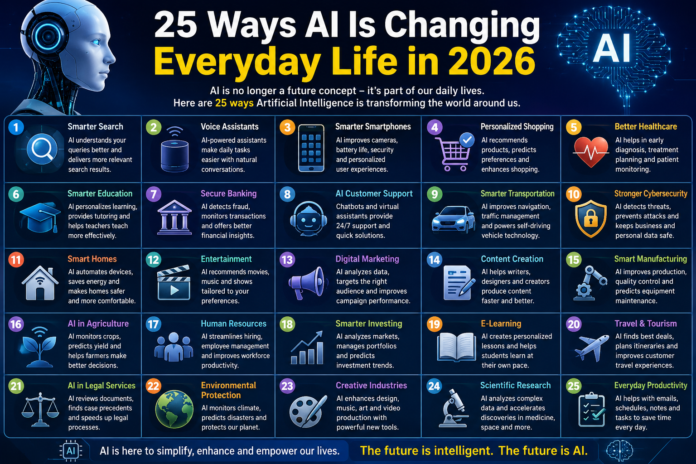
In this comprehensive guide, we explore 25 practical ways Artificial Intelligence is changing everyday life and shaping the future in 2026.
What Is Artificial Intelligence?
Artificial Intelligence refers to computer systems that can perform tasks that normally require human intelligence. These tasks include understanding language, recognising images, solving problems, learning from experience, making predictions, and generating content.
Unlike traditional software that follows fixed instructions, AI systems continuously improve by analysing large amounts of data. This ability allows AI to become more accurate and efficient over time.
Modern AI combines several advanced technologies, including:
- Machine Learning
- Deep Learning
- Natural Language Processing (NLP)
- Computer Vision
- Robotics
- Predictive Analytics
- Generative AI
Together, these technologies enable computers to perform increasingly complex tasks with minimal human intervention.
How Artificial Intelligence Works
Artificial Intelligence relies on algorithms trained using massive datasets. During training, AI identifies patterns, relationships, and trends within the data.
For example, if an AI system analyses millions of images of cats and dogs, it learns to distinguish between the two. Once trained, it can accurately classify new images it has never seen before.
Most AI systems follow four key steps:
Data Collection
Large amounts of high-quality data are gathered from various sources.
Training
Machine learning algorithms analyse the data to identify patterns.
Testing
The AI model is evaluated using new information to measure its accuracy.
Continuous Improvement
As additional data becomes available, the AI system refines its predictions and performance.
This continuous learning process makes AI increasingly powerful over time.
Benefits of Artificial Intelligence
The growing popularity of AI is driven by its ability to solve problems more efficiently than traditional methods.
Some of the biggest benefits include:
Increased Productivity
AI automates repetitive tasks, allowing employees to focus on more valuable work.
Better Decision-Making
Businesses use AI to analyse huge volumes of data and identify opportunities that humans might overlook.
Improved Customer Experience
AI-powered chatbots and recommendation systems provide personalised experiences around the clock.
Cost Savings
Automation reduces operational expenses and improves efficiency.
Faster Innovation
AI accelerates research, product development, and scientific discoveries.
Enhanced Accuracy
AI minimises human error in areas such as healthcare, manufacturing, and financial analysis.
25 Ways AI Is Changing Everyday Life
1. AI-Powered Search Engines
Search engines have evolved dramatically thanks to AI.
Instead of simply matching keywords, modern search engines understand user intent, context, and natural language. This allows users to receive more relevant and personalised search results.
AI also generates summaries, answers complex questions, and recommends related information, making online research faster than ever before.
2. Smart Voice Assistants
Voice assistants have become household companions.
They can:
- Set reminders
- Play music
- Control smart home devices
- Answer questions
- Send messages
- Manage calendars
- Provide weather updates
- Translate languages
As natural language processing improves, voice assistants are becoming more conversational and capable of handling complex requests.
3. AI in Smartphones
Modern smartphones rely heavily on Artificial Intelligence.
AI improves:
- Camera quality
- Face recognition
- Battery optimisation
- Voice typing
- Spam detection
- Language translation
- Photo editing
- Security
Your phone continuously learns your habits, making it more personalised over time.
4. Personalised Online Shopping
Online retailers use AI to recommend products based on browsing history, previous purchases, interests, and customer behaviour.
AI helps shoppers by providing:
- Personalised recommendations
- Dynamic pricing
- Size suggestions
- Virtual try-ons
- Faster customer service
This creates a more convenient shopping experience while increasing sales for businesses.
5. AI in Healthcare
Healthcare has experienced one of the biggest transformations through Artificial Intelligence.
AI now assists doctors by:
- Detecting diseases earlier
- Analysing medical scans
- Predicting patient outcomes
- Monitoring chronic conditions
- Personalising treatment plans
Hospitals also use AI to manage appointments, optimise staffing, and reduce administrative workloads.
6. AI in Education
Education has become more personalised thanks to AI-powered learning platforms.
Students receive customised lessons based on their strengths and weaknesses.
AI also provides:
- Instant feedback
- Automated grading
- Interactive tutoring
- Language learning assistance
- Study recommendations
Teachers benefit by spending less time on repetitive administrative tasks and more time supporting students.
7. AI in Banking and Finance
Banks increasingly rely on Artificial Intelligence to improve security and customer service.
AI helps detect fraudulent transactions in real time, assess loan applications, monitor spending patterns, and provide personalised financial advice.
Many banking apps now include AI assistants that answer customer questions 24 hours a day.
8. AI-Powered Customer Support
Customer service has changed dramatically through AI chatbots.
Modern AI assistants can:
- Answer frequently asked questions
- Track orders
- Process refunds
- Schedule appointments
- Solve technical problems
Businesses benefit from lower support costs while customers receive instant assistance without waiting for human agents.
Why AI Adoption Continues to Grow
Several factors are driving AI adoption across industries:
- More affordable cloud computing
- Faster internet connectivity
- Improved computing power
- Massive data availability
- Better machine learning models
- Growing business demand for automation
As AI technology becomes more accessible, organisations of all sizes are finding new ways to integrate it into their daily operations.
9. AI in Transportation
Transportation has become safer, faster, and more efficient thanks to AI-powered technologies.
Artificial Intelligence helps improve:
- Navigation systems
- Route optimisation
- Traffic prediction
- Fleet management
- Vehicle maintenance
- Fuel efficiency
Navigation apps analyse live traffic conditions and suggest the quickest routes, helping drivers avoid congestion. Logistics companies use AI to optimise delivery schedules, reducing costs and improving customer satisfaction.
Self-driving vehicle technology is also advancing rapidly. Although fully autonomous vehicles are still being refined, many modern cars already include AI-assisted features such as lane-keeping assistance, adaptive cruise control, automatic emergency braking, and intelligent parking systems.
10. AI in Cybersecurity
As cyber threats become more sophisticated, Artificial Intelligence has become a powerful tool for protecting digital systems.
Traditional security software often relies on predefined rules, while AI continuously learns from new threats and adapts in real time.
AI strengthens cybersecurity by:
- Detecting unusual login attempts
- Identifying malware
- Preventing phishing attacks
- Monitoring network activity
- Detecting ransomware
- Analysing suspicious behaviour
Businesses use AI security platforms to identify threats within seconds, significantly reducing the risk of data breaches.
11. AI in Smart Homes
Smart homes are becoming increasingly intelligent through AI-powered automation.
Connected devices learn user preferences and automate daily tasks.
Examples include:
- Smart lighting
- Intelligent thermostats
- Security cameras
- Smart locks
- Robot vacuum cleaners
- Voice-controlled appliances
For example, AI can automatically adjust room temperatures based on occupancy, switch off unused lights, and notify homeowners of unusual activity through intelligent security systems.
These innovations improve comfort, convenience, and energy efficiency.
12. AI in Entertainment
The entertainment industry relies heavily on Artificial Intelligence to personalise user experiences.
Streaming platforms analyse viewing habits to recommend films, television series, documentaries, and music tailored to individual preferences.
AI also supports:
- Video editing
- Music recommendations
- Content moderation
- Gaming experiences
- Animation
- Visual effects
Gamers benefit from AI-controlled characters that adapt to player behaviour, making games more challenging and realistic.
13. AI in Digital Marketing
Digital marketing has been transformed by Artificial Intelligence.
Businesses use AI to understand customer behaviour and improve marketing performance.
AI assists marketers by:
- Analysing customer data
- Predicting buying behaviour
- Personalising advertisements
- Improving email marketing
- Generating content ideas
- Optimising search engine rankings
AI-powered analytics allow companies to identify high-performing campaigns while reducing advertising costs.
Search engine optimisation (SEO) professionals also use AI to research keywords, identify content opportunities, and analyse competitors more efficiently.
14. AI for Content Creation
Content creators increasingly rely on AI to streamline their workflows.
Artificial Intelligence can assist with:
- Blog writing
- Video scripts
- Social media captions
- Email newsletters
- Product descriptions
- Image generation
- Video editing
- Grammar checking
While human creativity remains essential, AI significantly reduces the time required for brainstorming, editing, and content production.
Businesses can publish more content without sacrificing quality.
15. AI in Manufacturing
Manufacturing companies use AI to improve productivity and reduce operational costs.
AI-powered factories employ intelligent systems to monitor production lines, predict equipment failures, and maintain quality standards.
Benefits include:
- Reduced downtime
- Predictive maintenance
- Quality control
- Inventory management
- Energy optimisation
- Automated inspections
Computer vision systems inspect products far more quickly than manual inspections while maintaining high levels of accuracy.
16. AI in Agriculture
Agriculture has embraced Artificial Intelligence to improve food production and sustainability.
Farmers use AI-powered technologies to monitor crops, analyse soil conditions, predict weather patterns, and optimise irrigation systems.
AI applications include:
- Crop monitoring
- Pest detection
- Yield prediction
- Smart irrigation
- Livestock monitoring
- Precision farming
These technologies help farmers increase productivity while reducing water usage, fertiliser consumption, and environmental impact.
17. AI in Human Resources
Recruitment has become more efficient with AI-powered hiring tools.
Human Resources departments use AI to:
- Screen CVs
- Schedule interviews
- Assess candidate skills
- Answer applicant questions
- Analyse workforce trends
- Improve employee engagement
AI reduces repetitive administrative work, allowing HR professionals to focus on strategic decision-making and employee development.
18. AI in Financial Investing
Investment firms and individual investors increasingly rely on AI for market analysis.
AI can process enormous amounts of financial information within seconds, identifying trends that humans may overlook.
Investment platforms use AI for:
- Portfolio management
- Risk assessment
- Stock market analysis
- Fraud detection
- Automated trading
- Financial forecasting
Although AI provides valuable insights, investors should still combine AI recommendations with professional advice and personal research.
The Growing Importance of AI Skills
As Artificial Intelligence becomes integrated into more industries, employers increasingly value AI-related skills.
Professionals who understand AI tools gain advantages in careers such as:
- Marketing
- Software development
- Healthcare
- Education
- Finance
- Customer service
- Engineering
- Business management
Learning how to use AI responsibly is becoming an essential workplace skill rather than a specialised technical ability.
Ethical Considerations of Artificial Intelligence
Despite its many benefits, AI raises important ethical questions.
Some of the key concerns include:
Data Privacy
AI systems often require large amounts of personal information, making privacy protection essential.
Bias
AI models can unintentionally reflect biases present in their training data, leading to unfair outcomes.
Transparency
Users should understand how AI systems make important decisions, particularly in healthcare, finance, and legal services.
Employment
Automation may replace certain routine jobs while creating new opportunities that require different skills.
Governments, businesses, and technology companies continue working together to develop responsible AI guidelines that balance innovation with public trust.
Preparing for an AI-Powered Future
Rather than fearing Artificial Intelligence, individuals and organisations should focus on adapting to technological change.
Useful strategies include:
- Learning AI fundamentals
- Developing digital skills
- Embracing continuous learning
- Using AI as a productivity tool
- Staying informed about new technologies
- Understanding ethical AI practices
Those who combine human creativity with AI-powered tools are likely to remain competitive in the modern workplace.
19. AI in Online Education and E-Learning
Online education has become more effective thanks to Artificial Intelligence. Learning platforms now use AI to personalise courses based on a student’s progress, strengths, and learning style.
AI-powered educational tools can:
- Recommend learning materials
- Create personalised study plans
- Provide instant feedback
- Translate lessons into multiple languages
- Identify areas where students need additional support
Virtual tutors are also available 24/7, allowing students to receive guidance whenever they need it.
20. AI in Travel and Tourism
Travelling has become easier with AI-driven services.
Travel companies use Artificial Intelligence to:
- Recommend destinations
- Predict flight prices
- Suggest hotels
- Translate languages
- Optimise travel itineraries
- Improve customer support
Many airlines now use AI to improve scheduling, reduce delays, and provide passengers with real-time updates.
Hotels also rely on AI-powered chatbots to answer guest enquiries and streamline the booking process.
21. AI in Legal Services
Law firms and legal professionals increasingly use AI to improve efficiency.
Artificial Intelligence helps lawyers by:
- Reviewing contracts
- Searching legal documents
- Conducting legal research
- Organising case files
- Identifying relevant precedents
Although AI cannot replace experienced legal professionals, it significantly reduces the time spent on repetitive administrative work.
22. AI in Environmental Protection
Artificial Intelligence plays an important role in protecting the environment.
Scientists and environmental organisations use AI to:
- Monitor climate change
- Predict natural disasters
- Track wildlife populations
- Reduce energy consumption
- Improve recycling systems
- Detect illegal deforestation
Smart energy systems also use AI to balance electricity demand and improve renewable energy efficiency.
These innovations contribute to more sustainable communities and better resource management.
23. AI in Creative Industries
Contrary to popular belief, AI is not replacing creativity—it is enhancing it.
Designers, writers, musicians, photographers, and filmmakers use AI to speed up creative workflows.
AI supports creative professionals by:
- Generating design ideas
- Editing photographs
- Creating music
- Producing video effects
- Brainstorming content
- Enhancing illustrations
Human creativity remains the driving force, while AI serves as a powerful assistant.
24. AI in Scientific Research
Scientific research has accelerated significantly because of Artificial Intelligence.
Researchers use AI to analyse massive datasets much faster than traditional methods.
AI contributes to discoveries in:
- Medicine
- Genetics
- Climate science
- Astronomy
- Chemistry
- Engineering
By identifying hidden patterns in data, AI helps scientists solve complex problems and develop innovative solutions more quickly.
25. AI for Everyday Productivity
One of the most noticeable impacts of Artificial Intelligence is improved personal productivity.
Millions of people now use AI every day to:
- Write emails
- Summarise documents
- Generate presentations
- Manage calendars
- Translate languages
- Create reports
- Organise notes
- Plan projects
Businesses and individuals save countless hours each week by automating repetitive tasks.
Rather than replacing human effort, AI enables people to focus on creative thinking, decision-making, and problem-solving.
Will Artificial Intelligence Replace Human Jobs?
One of the most frequently asked questions about AI is whether it will replace human workers.
The answer is more complex than a simple yes or no.
AI will automate many repetitive and predictable tasks, particularly those involving data processing or routine administrative work. However, it is also creating entirely new career opportunities in fields such as:
- AI development
- Machine learning engineering
- Data science
- Prompt engineering
- Cybersecurity
- AI ethics
- Robotics
- Digital marketing
- AI consulting
History has shown that technological innovation often changes the nature of work rather than eliminating it altogether.
The professionals who adapt, learn new skills, and embrace AI tools are likely to benefit the most from this technological transformation.
Challenges and Risks of Artificial Intelligence
Despite its many advantages, AI presents several important challenges.
Privacy Concerns
AI systems often process large volumes of personal information. Organisations must ensure that user data is collected and stored responsibly.
Bias in AI Models
If AI is trained on biased or incomplete data, it can produce unfair or inaccurate results. Developers must continually test and improve models to reduce bias.
Cybersecurity Threats
While AI strengthens security, cybercriminals can also use AI to create more advanced attacks. Ongoing investment in cybersecurity is essential.
Ethical Issues
Questions surrounding transparency, accountability, copyright, and responsible AI use continue to shape global discussions.
Job Displacement
Some routine roles may become automated, making workforce reskilling and lifelong learning increasingly important.
The Future of Artificial Intelligence
Artificial Intelligence is expected to become even more integrated into everyday life over the coming years.
Future developments may include:
- More advanced personal AI assistants
- Improved healthcare diagnostics
- Smarter transportation systems
- Greater automation in businesses
- AI-powered scientific discoveries
- Intelligent smart cities
- Better environmental monitoring
- Highly personalised education
- More capable robotics
- Enhanced cybersecurity systems
As AI evolves, collaboration between humans and intelligent machines will become increasingly common across almost every profession.
Frequently Asked Questions
What is Artificial Intelligence?
Artificial Intelligence is technology that enables computers to perform tasks requiring human intelligence, such as learning, reasoning, recognising patterns, and understanding language.
How is AI used in everyday life?
AI is used in smartphones, online shopping, banking, healthcare, education, navigation, customer support, streaming services, and smart home devices.
Is Artificial Intelligence safe?
AI can be safe when developed and used responsibly. Governments and technology companies continue to create regulations and ethical standards to minimise risks.
Will AI replace all jobs?
No. AI is expected to automate certain tasks while creating new career opportunities that require human creativity, critical thinking, and emotional intelligence.
What industries benefit most from AI?
Healthcare, finance, education, manufacturing, agriculture, transportation, cybersecurity, marketing, retail, and scientific research are among the industries experiencing significant benefits.
Can small businesses use AI?
Yes. Affordable AI tools are available for customer service, marketing, content creation, data analysis, accounting, and business automation.
Is learning AI difficult?
Many beginner-friendly AI tools require little or no programming knowledge. Numerous online courses and tutorials make learning AI more accessible than ever.
Why is AI becoming so popular?
AI saves time, improves accuracy, reduces costs, enhances productivity, and enables organisations to make smarter decisions using data.
Can AI think like humans?
No. AI can analyse information and recognise patterns, but it does not possess human consciousness, emotions, or independent understanding.
What is the biggest advantage of AI?
Its greatest advantage is the ability to process enormous amounts of information quickly, enabling faster decisions and more efficient workflows.
Final Thoughts
Artificial Intelligence is no longer a technology of the future—it is a defining feature of modern life. From the moment we unlock our smartphones in the morning to the way businesses analyse data, hospitals diagnose illnesses, students learn online, and companies serve customers, AI is transforming how the world operates.
The 25 examples explored in this guide demonstrate that AI is not limited to one industry or profession. It is improving healthcare, education, transportation, finance, manufacturing, agriculture, entertainment, environmental protection, scientific research, and everyday productivity.
While challenges such as privacy, ethics, and workforce adaptation remain important, the opportunities created by Artificial Intelligence are even greater. Individuals who understand AI and use it responsibly will be well positioned to thrive in the digital economy.
As we move further into 2026 and beyond, Artificial Intelligence will continue to shape innovation, unlock new possibilities, and redefine how people live, work, and connect with one another.

