The financial world is witnessing a quiet revolution. In May 2026 alone, monthly transaction volume on crypto-linked payment cards hit an astonishing $7.8 billion, representing a staggering 230% year-over-year surge . This isn’t just speculative trading—it’s real people using cryptocurrency for groceries, restaurant meals, and online shopping. The question is no longer if crypto will become spendable money, but how fast.
This comprehensive guide explores everything you need to know about crypto-linked debit cards in 2026—from how they work to whether they’re safe, which providers lead the market, and what hidden fees might await you.
What Is a Crypto Linked Debit Card?
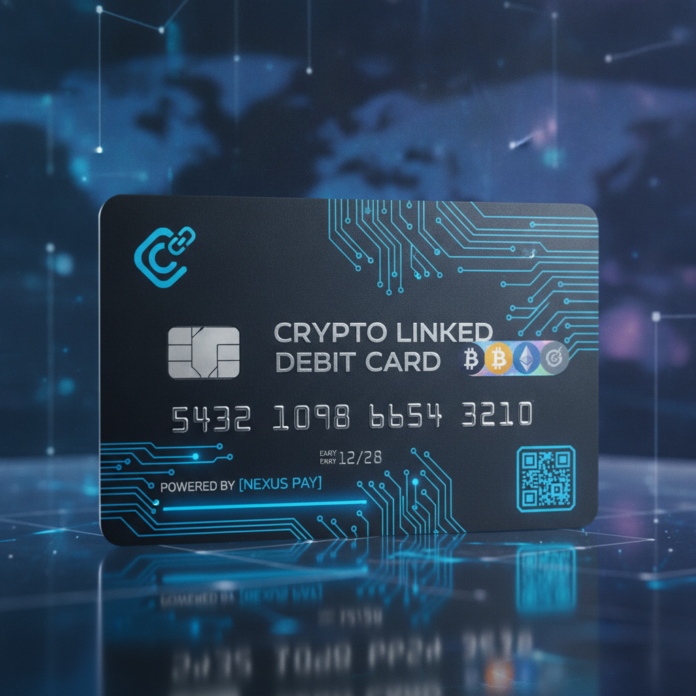
A Crypto Linked Debit Card is a payment card—typically issued on the Visa or Mastercard network—that enables you to spend your cryptocurrency holdings for everyday purchases, just as you would with a traditional bank debit card . The critical difference lies in the funding source: instead of drawing from a bank account, the card pulls funds from your crypto wallet or exchange account.
When you make a purchase, the card provider automatically converts just enough cryptocurrency into your local currency at the point of sale. From the merchant’s perspective, it’s a standard card transaction; they receive fiat currency and never directly interact with crypto . This clever mechanism eliminates the need for merchants to accept digital assets, making crypto spending practical anywhere traditional cards are accepted.
Visa currently dominates this space, capturing approximately 90% of crypto card transactions through partnerships with blockchain-native firms . Meanwhile, Mastercard has signaled its commitment with a $1.8 billion acquisition of BVNK, a stablecoin infrastructure firm . The infrastructure is scaling rapidly: Visa now supports more than 130 card programs linked to stablecoins across over 40 countries .
How Does a Crypto Linked Debit Card Work?
The mechanics vary depending on the card model, but the core principle remains consistent: bridge crypto assets to traditional payment rails.
The Transaction Flow
- You initiate a purchase by tapping, swiping, or entering your card details online.
- The card provider checks your crypto balance and determines the required amount in your chosen cryptocurrency.
- Real-time conversion occurs through liquidity providers and algorithms that secure current market rates . The conversion typically completes within 2-5 seconds .
- Fiat currency is transmitted through traditional payment networks (Visa or Mastercard) to the merchant’s bank.
- Your crypto balance is reduced by the spent amount, including any applicable fees.
Three Primary Card Models
The market in 2026 features three distinct architectures :
1. Prepaid Crypto Cards (Pre-Conversion)
This is the simplest model. You convert crypto to fiat when you fund the card, then spend like a standard prepaid debit card. Crypto.com‘s Visa Card pioneered this approach in 2018 and remains among the most recognized products . The advantage is predictability; the trade-off is losing flexibility if crypto prices move favorably after conversion.
2. Custodial Crypto Debit Cards
Here, you hold crypto in an account managed by the provider (typically an exchange), and conversion happens only at the moment of payment. Major exchanges like Binance, Coinbase, Kraken, and Bybit offer cards in this category . You don’t need to sell assets in advance, but the provider custodies your funds until spending occurs.
3. Non-Custodial Wallet-Linked Cards
The newest and most innovative model connects directly to your self-custody Web3 wallet. You retain full control of your private keys until the transaction moment. MetaMask Card is the standout example, with the service recently expanding to 17 Latin American markets and surpassing 50 countries globally . In this model, smart contracts handle conversion via partners like Baanx, while Mastercard processes the payment .
Is a Crypto Linked Debit Card Safe to Use?
Safety is a multi-layered question with crypto debit cards. Here’s what you need to know.
Security Features
Reputable providers implement robust security measures including:
- Two-factor authentication (2FA) for account access
- Biometric verification through mobile apps
- Virtual cards for online transactions, which can be instantly replaced if compromised
- Real-time transaction notifications to flag unauthorized activity
- Ability to freeze/unfreeze cards instantly through apps
Major providers like MetaMask emphasize their decade-long security track record, noting their wallet is trusted by over 100 million users worldwide . Cards issued by FCA-authorized institutions, such as Monavate for the 1inch Card, add regulatory oversight .
The Dark Side: A Critical Risk
However, there’s a significant security gap in the ecosystem. According to Crystal Intelligence research covering nearly 100 crypto card providers:
- 67.7% of providers offer no KYC (Know Your Customer) or low-friction identity verification
- Between January 2024 and January 2026, traced on-chain flows linked to crypto card funding wallets totaled over $1.18 billion**, including **$166.4 million in high-risk flows
The compliance gap is structural: Visa and Mastercard onboard the BIN sponsor (issuing bank), the BIN sponsor onboards the card provider, but the card provider’s KYC on end users is often weak or absent. No regulated entity in the chain adequately verifies the end user’s identity in many cases .
This means if you choose a low-KYC provider, your card could be linked to wallets exposed to darknet markets, sanctioned entities, or fraud—exposing you to potential legal and financial risks .
Recommendation: Always choose a card from a reputable provider with clear KYC requirements. If a platform offers a card with zero identity verification, run.
Why Are Crypto Linked Debit Cards Becoming Popular?
The 230% year-over-year volume growth isn’t accidental. Several converging factors explain the surge.
1. Stablecoins Provide Stability
Unlike volatile cryptocurrencies like Bitcoin (which can swing 5-15% daily), stablecoins maintain a near-fixed value . USDT and USDC deviations typically remain within 0.1-0.5% of dollar value even during market stress . This makes stablecoin-funded cards practical for everyday spending—users know their purchasing power won’t evaporate overnight.
Consumer data confirms the shift: OKX’s stablecoin-linked card shows grocery purchases leading all spending categories at 26%, followed by restaurants at 18% and online shopping at 13% . As the OKX team noted: “When crypto pays for lunch, payment adoption is real.”
2. Global Acceptance Through Visa and Mastercard
Visa’s network alone supports stablecoin spending at 80 million merchant locations worldwide . Mastercard extends to over 150 million global merchants . This universal acceptance eliminates the adoption barrier that once plagued crypto payments.
In March 2026, Visa rolled out stablecoin-linked cards in partnership with fintech firm Bridge, targeting 18 countries in Latin America with expansion plans for Asia, Africa, and the Middle East . MetaMask’s recent expansion into 17 Latin American markets further demonstrates the industry’s aggressive geographic scaling .
3. Lucrative Rewards
Crypto debit cards frequently offer superior rewards compared to traditional cards. Cashback rates range from 1% to 10% in cryptocurrency, and some premium tiers deliver up to 14% annual interest on idle balances .
The structural difference is significant: traditional cards offer 0.5-3% cashback in fiat or points, while crypto rewards are paid in digital assets that may appreciate over time, potentially enhancing effective returns .
4. Financial Inclusion
Latin America’s demand is particularly instructive. With ongoing inflation in Argentina, Venezuela, and parts of Central America, users are flocking to dollar-denominated stablecoins as a currency hedge . The MetaMask card allows them to spend USDC or USDT directly at Mastercard merchants—a significant improvement over converting assets through brokers . The region’s $145 billion in remittance flows are increasingly settling through stablecoins, with cards providing a seamless spending mechanism .
Can You Use a Crypto Linked Debit Card for Online Payments?
Yes—and this is one of their primary use cases.
Both virtual and physical crypto debit cards can be used for online shopping, subscriptions, and in-app purchases . Virtual cards, which exist only in digital form, are typically issued immediately after registration and are optimized for e-commerce . They offer enhanced security because card details can be instantly replaced if compromised.
Physical cards work identically online while adding the ability to make in-store purchases and ATM withdrawals . Many providers now support mobile wallet integration through Apple Pay and Google Pay, enabling contactless payments from smartphones .
Example: The 1inch Card, a prepaid Mastercard, supports online purchases, in-store transactions, and ATM withdrawals wherever Mastercard is accepted—including via Apple Pay and Google Pay .
How to Get a Crypto Linked Debit Card in 2026
The process has become remarkably streamlined. Here’s a step-by-step guide:
Step 1: Choose Your Provider
Evaluate providers based on:
- Geographic availability: Some cards are region-locked. MetaMask Card, for instance, is available in select countries including the US (excluding New York and Vermont), UK, EU, Brazil, and Mexico .
- Supported assets: Determine whether you can spend the cryptocurrencies you hold. Most major providers support USDC, USDT, Bitcoin, Ethereum, and other major assets .
- Fee structure: Compare issuance fees, monthly fees, conversion spreads, and ATM withdrawal charges (more on this below).
- Card model: Decide between prepaid, custodial debit, or non-custodial wallet-linked.
Step 2: Complete KYC
Legitimate providers require identity verification. Be prepared to submit:
- Government-issued ID (passport, driver’s license)
- Proof of address (utility bill, bank statement)
- Selfie or live verification in some cases
Step 3: Fund Your Account
Link your crypto wallet or exchange account. For custodial cards, you’ll transfer assets to the provider. For non-custodial cards like MetaMask, you maintain control of your private keys and authorize transactions directly from your wallet .
Step 4: Activate Your Card
Virtual cards are often issued instantly and can be added to mobile wallets immediately . Physical cards are mailed and typically arrive within 5-14 business days, depending on your location .
Popular Providers in 2026
| Card | Model | Key Feature | Region |
| MetaMask Card | Non-custodial | Self-custody, up to 3% cashback | 50+ countries |
| Crypto.com Visa | Prepaid | Tiered CRO rewards | US, EU, more |
| Coinbase Card | Custodial debit | 2-4% Bitcoin cashback | US only |
| Kraken Card | Custodial debit | 1% cashback, no monthly fees | US, UK, EU |
| Bitget Wallet Card | Non-custodial | Up to 10% APY on balances | Asia, EU |
| Binance Card | Custodial debit | Real-time conversion | EEA, LATAM |
What Are the Benefits of a Crypto Linked Debit Card?
1. Spend Crypto Everywhere
The most obvious benefit: use digital assets at millions of merchants without waiting for them to accept crypto payments.
2. No Manual Conversion
Eliminate the cumbersome process of logging into an exchange, placing a sell order, waiting for settlement, and transferring funds. The card handles everything in real time.
3. Superior Rewards
Earn crypto cashback that may appreciate in value, often at higher rates than traditional cards.
4. International Travel Savings
Traditional banks charge 2.5-3.5% foreign transaction fees. Many crypto debit cards eliminate these charges entirely, using real-time conversion at market rates .
5. Financial Inclusion
For the unbanked or underbanked, crypto debit cards provide access to financial services without requiring a traditional bank account .
6. Maintain Control (Non-Custodial Options)
With non-custodial cards, you retain full control over your assets until the exact moment of payment, minimizing counterparty risk .
Are Crypto Linked Debit Cards Better Than Traditional Debit Cards?
The answer depends on your financial priorities.
| Feature | Crypto Debit Card | Traditional Debit Card |
| Funding Source | Cryptocurrency wallet | Bank account |
| Conversion Fees | 0.5% to 2.5% per transaction | No conversion for same currency |
| Foreign Exchange | 0% to 1.5% | 2.5% to 3.5% |
| Rewards | 1% to 10% cashback in crypto | 0.5% to 3% cashback in fiat |
| Banking Requirements | Only crypto wallet + KYC | Established bank account/credit history |
| Fraud Protection | Varies; may be limited | Built-in chargebacks (for credit) |
| Tax Implications | Taxable events on each spend | Not applicable |
| Regulatory Oversight | Evolving landscape | Highly regulated |
Verdict: Crypto debit cards excel for international travel, reward optimization, and accessing financial services without a bank account. Traditional cards offer superior fraud protections and predictable tax treatment. For most users, the optimal strategy may involve using both—a crypto card for daily spending with rewards, and a traditional card for backup and major purchases.
Which Banks Offer Crypto Linked Debit Cards?
Traditional banks have been cautious, but the landscape is shifting.
Direct Bank-Issued Cards
Few major banks directly issue crypto-linked debit cards. However, Swiss bank Fiat24 partnered with SafePal to issue virtual Mastercard cards with full IBAN support, allowing USDC payments and bank transfers .
Fintech and Exchange Partnerships
Most crypto debit cards come from crypto-native platforms, not traditional banks. These include:
- Crypto.com (partnered with Visa)
- Binance, Coinbase, Kraken, Bybit (exchange-issued cards)
- MetaMask, Bitget Wallet, Gnosis (non-custodial wallet cards)
- Wirex, BitPay (fintech platforms)
The Banking Integration Trend
Mastercard’s $1.8 billion BVNK acquisition and Visa’s Bridge partnership signal that traditional payment giants are building crypto infrastructure . While banks may not issue these cards directly, the payment rails they rely on are increasingly crypto-enabled. The distinction between “bank card” and “crypto card” is blurring—soon, most debit cards may be crypto-capable without users even realizing it.
Do Crypto Linked Debit Cards Have Hidden Fees?
This is one of the most critical questions—and the answer is often yes. Providers may obscure fees in complex structures.
Common Fee Categories
1. Issuance and Maintenance Fees
| Fee Type | Typical Range |
| Virtual card issuance | $10 |
| Physical card issuance | $100 |
| Monthly/annual fees | $0 to $199 annually (Metal tier) |
2. Transaction and Conversion Fees
- Conversion spreads: Often embedded in exchange rates rather than shown as a separate line item
- FX transaction fees: 1.2% (Tevau) to 2.2% total (RedotPay: 1% conversion + 1.2% FX)
- Top-up fees: ~1% (Tevau), 0% for direct deposits (RedotPay), 3% via credit card
3. ATM Withdrawal Fees
- Typically 1.9% to 3% of withdrawal amount
- Some cards offer fee-free withdrawals up to certain limits ($5,000/month for Metal tier)
4. Small and Minor Fees
Watch for charges like:
- $0.20 after the 5th small transaction (RedotPay)
- $0.50 after the 3rd declined transaction
- Card deletion fees ($2)
Fee Comparison Example
| Fee | Tevau | RedotPay |
| FX transaction | 1.2% | Up to 2.2% (1% conversion + 1.2% FX) |
| ATM withdrawal | 1.9% | 2% (up to $10K/mo), 3% above |
| Small transaction | None | $0.20 after 5th |
| Declined transaction | None | $0.50 after 3rd |
How to Avoid Hidden Fees
- Read the fine print on conversion mechanics—spreads aren’t always transparent.
- Calculate total fees for your usage pattern. If you travel internationally, FX fees matter most. If you spend small amounts daily, watch for per-transaction charges.
- Compare effective rates rather than advertised “0% fees.”
- Look for fee-free tiers that match your spending volume.
The Tax Elephant in the Room
A critical consideration: in many jurisdictions, each cryptocurrency transaction triggers a taxable event . If your crypto has appreciated since you acquired it, spending it with a debit card may create a capital gain subject to tax.
With stablecoins, this is less concerning since capital gains are rarely involved. But for Bitcoin, Ethereum, and other volatile assets, the tax implications can be significant and require careful record-keeping.
The Bottom Line
The Crypto Linked Debit Card has evolved from a niche curiosity to a mainstream financial tool processing billions in monthly transactions. Whether you’re a crypto investor seeking to spend profits, a traveler avoiding FX fees, or an unbanked individual seeking financial access, these cards offer compelling utility.
However, the ecosystem carries significant caveats: potential tax exposure, custodial risks, and—most alarmingly—systemic KYC gaps that expose some users to financial crime risks . Always choose a reputable provider with clear KYC requirements, read the fee structure carefully, and maintain a backup payment method.
The future is clear: crypto is becoming spendable money. The only question is how you’ll choose to engage with this transformation.

