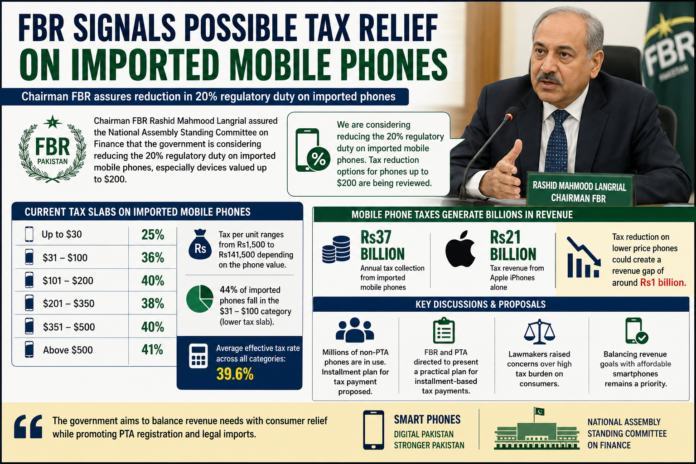
Pakistan’s Federal Board of Revenue (FBR) has indicated that relief may be on the way for consumers purchasing imported mobile phones. During a meeting of the National Assembly Standing Committee on Finance, FBR Chairman Rashid Mahmood Langrial assured lawmakers that the government is considering reducing the 20 percent regulatory duty currently imposed on imported mobile devices.
The announcement has generated significant interest among consumers, retailers, and industry stakeholders, particularly at a time when smartphone prices remain high due to taxes, duties, and currency fluctuations. If implemented, the move could make imported smartphones more affordable and encourage greater compliance with the country’s mobile registration system.
Finance Committee Reviews Mobile Phone Tax Structure
The discussion took place during a session of the National Assembly Standing Committee on Finance chaired by Syed Naveed Qamar. The committee reviewed several important economic and taxation matters, including mobile phone taxes, automobile policies, electric vehicles, and import duties.
A major focus of the meeting was the tax burden placed on imported mobile phones. Members of the committee raised concerns that the current tax structure significantly increases the retail price of smartphones, making them difficult to afford for many consumers.
Responding to these concerns, FBR Chairman Rashid Mahmood Langrial stated that the government is open to reviewing the regulatory duty imposed on imported devices. He specifically noted that lower-priced smartphones, particularly those valued at up to $200, could be considered for tax reductions.
Current Tax Rates on Imported Phones
During the briefing, FBR officials provided a detailed breakdown of the taxes currently applied to imported mobile phones.
According to officials:
- Phones valued up to $30 face a tax rate of 25%.
- Devices priced between $31 and $100 are taxed at 36%.
- Smartphones valued between $101 and $200 carry an effective tax rate of 40%.
- Devices worth $201 to $350 face an effective tax rate of 38%.
- Smartphones valued between $351 and $500 are taxed at 40%.
- Phones costing more than $500 face an effective tax burden of approximately 41%.
The officials explained that tax liabilities increase as the value of a mobile phone rises. Depending on the category, taxes can range from approximately Rs1,500 per device to as much as Rs141,500 on premium smartphones.
Millions of Non-PTA Phones in Use
Committee members also highlighted the widespread use of non-PTA-approved smartphones across Pakistan. According to lawmakers, millions of devices currently operating in the market are not officially registered through the Pakistan Telecommunication Authority (PTA) system.
Many consumers avoid registration because of the high tax costs associated with imported phones. As a result, lawmakers suggested introducing an installment-based payment system that would allow users to pay mobile registration taxes over time rather than in a single payment.
Members argued that installment plans are commonly available around the world for a variety of consumer products and services. Such a system could make compliance easier while increasing overall tax collection.
Following the discussion, Committee Chairman Syed Naveed Qamar directed both the FBR and PTA to jointly develop a practical proposal regarding installment-based tax payments for mobile devices.
Questions Raised About Tax Policy
The meeting also featured debate over the purpose of mobile phone taxation.
Committee member Hina Rabbani Khar questioned whether the existing tax regime is primarily intended to generate revenue or to provide protection to specific manufacturers operating in Pakistan.
She argued that consumers should not face such a significant financial burden when purchasing smartphones, especially in a digital age where mobile connectivity has become essential for education, business, and communication.
Her remarks reflected broader concerns among policymakers regarding the balance between revenue generation and consumer affordability.
Mobile Phone Taxes Generate Billions in Revenue
In response to questions from lawmakers, the FBR chairman emphasized that taxes collected from imported mobile phones play a vital role in achieving national revenue targets.
According to Langrial, the government collects approximately Rs37 billion annually from taxes imposed on imported mobile phones.
One of the most striking figures revealed during the meeting was the contribution made by premium smartphone brands. The chairman disclosed that Apple iPhones alone generate around Rs21 billion in annual tax revenue for the government.
This means that more than half of the total revenue collected from imported mobile devices comes from iPhone imports and registrations.
The chairman cautioned that any reduction in tax rates would create a revenue gap that would need to be compensated through alternative sources.
Impact of Tax Reductions
FBR officials estimated that reducing taxes on lower-cost smartphone categories could result in a revenue shortfall of around Rs1 billion.
However, supporters of tax relief argue that lower taxes could encourage greater compliance with PTA registration requirements and reduce incentives for illegal phone imports.
Industry experts also believe that making smartphones more affordable could support Pakistan’s broader digital transformation goals. Increased smartphone adoption can improve internet access, expand digital banking services, enhance e-commerce activity, and strengthen the country’s digital economy.
Lower taxes may also benefit students, freelancers, and small business owners who rely heavily on smartphones for education and work.
Balancing Revenue and Consumer Relief
The debate surrounding mobile phone taxation highlights the challenge faced by policymakers. On one hand, mobile phone taxes contribute billions of rupees to government revenues. On the other hand, high taxes increase consumer costs and may discourage legal imports.
As Pakistan continues its efforts to expand digital access and modernize its economy, finding the right balance between revenue collection and affordability will remain a key policy issue.
The assurance provided by the FBR chairman suggests that reforms may be under consideration. Whether those changes ultimately result in lower smartphone prices will depend on future discussions between the government, tax authorities, and lawmakers.
For millions of Pakistani consumers hoping for more affordable smartphones, any reduction in taxes could be a welcome development in the months ahead.
FAQ
Why is the FBR considering reducing mobile phone taxes?
The FBR is reviewing tax rates to make imported smartphones more affordable while encouraging legal registration and compliance.
What is the current regulatory duty on imported mobile phones?
Imported mobile phones currently face a 20% regulatory duty along with other applicable taxes.
How much tax revenue does Pakistan collect from imported phones?
The government collects approximately Rs37 billion annually from imported mobile phone taxes.
How much tax revenue comes from iPhones?
According to the FBR chairman, Apple iPhones generate around Rs21 billion in annual tax revenue.
What is the proposed installment plan for phone taxes?
Lawmakers have suggested allowing consumers to pay PTA registration and phone-related taxes in installments rather than a lump sum.
Will smartphone prices decrease if taxes are reduced?
If tax rates are lowered, imported smartphone prices could become more affordable, particularly for devices priced under $200.

