
The success of an event is the organizer’s top priority, as they often have a financial stake in it. Analyzing its successes and areas for improvement is essential to achieving those objectives.
The SWOT analysis, an ally of events
For each event, the organizer implements various strategies to achieve profitability while also trying to stand out. A SWOT analysis can help them achieve their objectives by examining key aspects.
A SWOT plan is divided into four categories: two related to the project itself, two related to the competition , (or similar events).
Internal analysis
The strengths and weaknesses of the event are part of the internal analysis in the SWOT plan. Simply put, it involves looking inside the event itself to see what its strengths and weaknesses are.
Strengths : These are the internal elements of the event that make people interested in it.
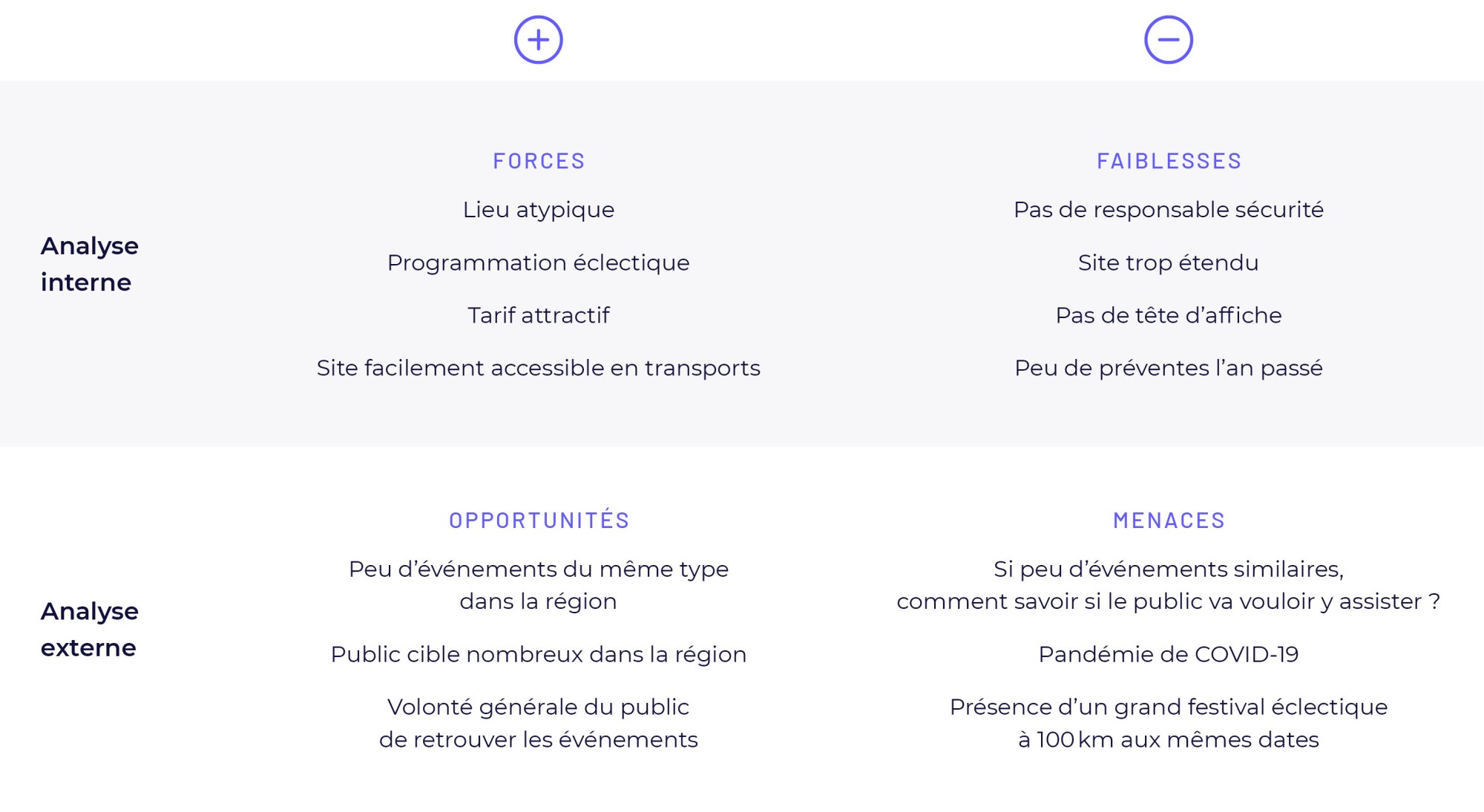
- What makes the event stand out ? An event’s strengths might include its unique venue, its eclectic and multidisciplinary program, or its timing. Strengths can also lie in the event team itself (a team that knows each other well and is competent in various key areas), the quality of the communication strategy, and the attractive price.
To calculate the forces, it is possible to directly ask your audience why they want to attend the event, for example.
Weaknesses : literally the opposite of strength,what the event can be improved internally. This involves examining the least successful results or the constraints related to the project.
- A weakness could, for example, be the absence of a security manager on the organizing team, leading to less effective measures than those implemented with the advice of a security expert. Another weakness could be an overly large venue, which might appear very empty in the event of poor sales, or a weak, unconvincing poster, or one lacking a headliner.
External analysis
The goal here is to analyze the competition, or similar events in the same area or of the same type, that might attract a similar audience. This allows the organizer to identify differentiating factors, whether positive or negative. These factors may relate to the organization itself, the target audience, or the programming choices.
Opportunities: This involves examining how the proposed event offers a competitive alternative to other similar events. By looking at other events of the same type or in the same area, it is possible to identify the strengths and weaknesses of each and compare them to those of the event in question.
- For example, in the region where the event is located, we might find that there are few events of the same type as the one offered by the organizer.
- Another example: in this region, the audience seems large and receptive to techno events. If the proposed event is also a techno party, the organizer could benefit from an already established audience, provided they find a way to differentiate themselves from other events on offer.
Threats: unlike opportunities, threats are external phenomena, which he cannot necessarily control, that can jeopardize the successful outcome of the event.
- The COVID-19 pandemic was a threat from 2020 to 2022.
- There are already a huge number of techno parties in the area.
- The public is not always receptive to the various techno music events on offer: most of the other events are not sold out.
It is therefore useful to list all this information in a table, which will be part of the overall marketing plan for the event .
Actions to be implemented
The next step is to ask the right questions to transform opportunities into concrete actions. By reviewing the SWOT analysis point by point, the organizer seeks to redefine their objectives and areas for improvement.
- Strengths: How to capitalize on the event’s strengths?
- Weaknesses : How to achieve better sales results? For example:
- How to boost pre-sales among participants?
- How can we engage the public with our artistic poster?
- Opportunities : How to define new objectives in the face of these opportunities?
- How do we reach our target audience? What marketing campaigns should we implement
?
- How do we reach our target audience? What marketing campaigns should we implement
- Threats : How to respond to changes in the sector and competition?
- How to captivate a target audience that is poorly informed about events in the region?
- How can we differentiate ourselves from the festival already present in the region?
- How to deal with inflation, both for the spectator (less purchasing power) and for the organization (higher costs)?
By answering these questions, the organizer is better equippe to make the right decisions that can increase sales. It’s also beneficial to conduct a debriefing at the end of the event to see how the issues were resolve.
Finally, when creating a new edition of the event, revisit this SWOT plan and analyze the developments in the sector in this new period/context, in order to reflect on and provide solutions to the new problems in force.