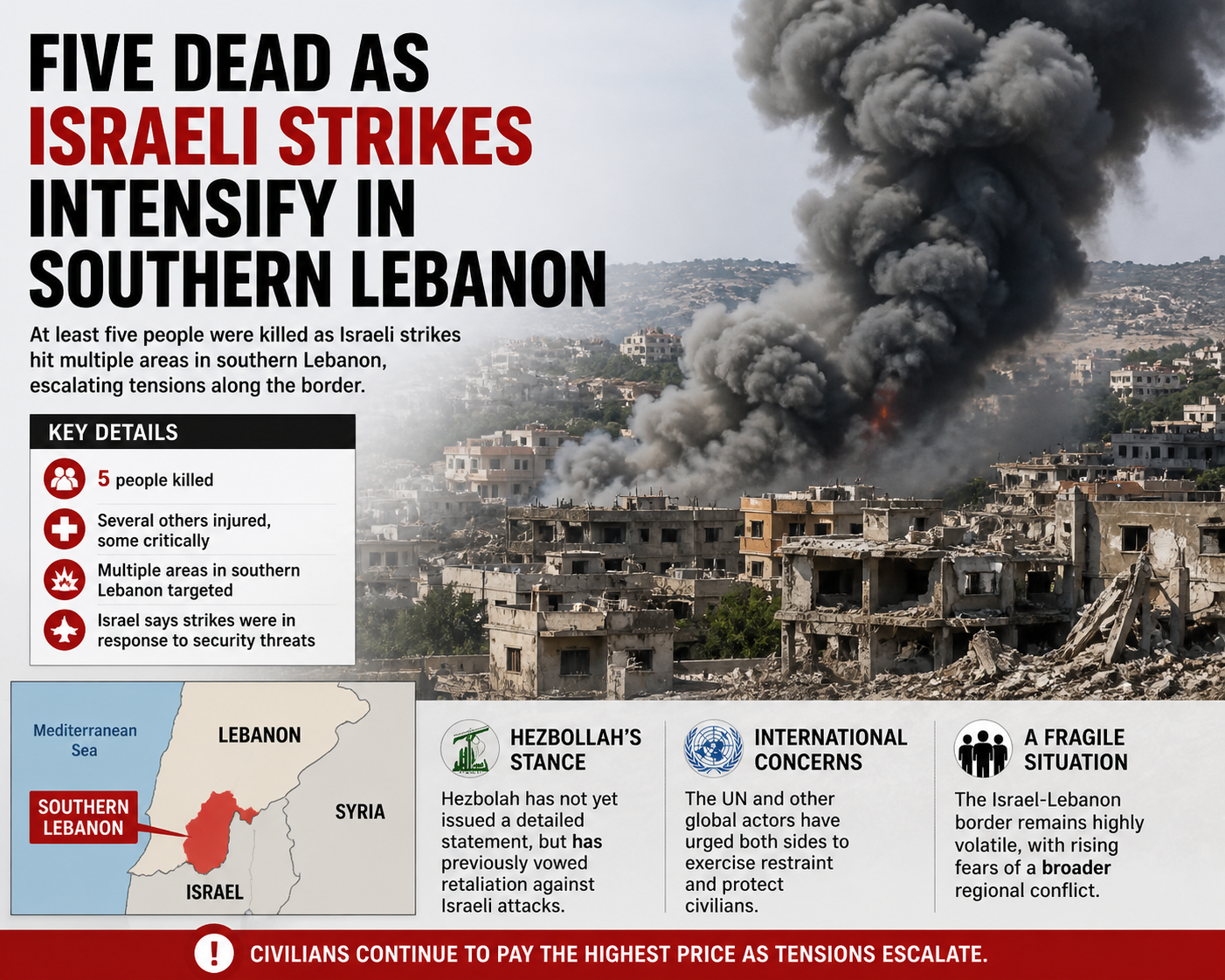
Tensions in the Middle East escalated sharply after a series of intensified Israeli airstrikes in southern Lebanon left at least five people dead and several others injured, according to local officials. The strikes mark one of the most serious flare-ups along the border in recent weeks, raising fears of a broader regional conflict.
Rising Violence Along the Border
The latest strikes targeted multiple مناطق in southern Lebanon, particularly near villages close to the Israeli frontier. Witnesses reported loud explosions followed by plumes of smoke rising from residential and شبه-rural areas.
The Israel Defense Forces (IDF) stated that the operations were in response to what it described as “ongoing security threats,” including cross-border rocket fire and militant activity. Officials claimed that the strikes were aimed at infrastructure linked to armed groups operating in the المنطقة.
Civilian Impact and Casualties
Local authorities in southern Lebanon confirmed that five individuals were killed, with several others wounded, some critically. Emergency services rushed to the scene, transporting the injured to nearby hospitals already under strain from previous clashes.
Residents described scenes of panic and destruction, with homes damaged and families fleeing to safer areas. المدنيون remain the most vulnerable in these escalating exchanges, as strikes often hit populated zones.
Hezbollah’s Position
The Lebanese militant group Hezbollah, which maintains a strong presence in southern Lebanon, has yet to issue a detailed statement on the latest incident. However, in past escalations, the group has vowed retaliation against Israeli military actions.
Analysts suggest that any direct response from Hezbollah could further intensify the situation, potentially dragging the region into a wider conflict involving multiple actors.
Regional and International Concerns
The escalation has drawn concern from international observers, with calls for restraint coming from various global organisations. The United Nations urged both sides to de-escalate tensions and prioritise civilian safety.
Diplomatic sources warn that continued hostilities could destabilise not only the Israel-Lebanon border but also the broader Middle East, where multiple conflicts are already ongoing.
A Fragile Situation
The border between Israel and Lebanon has remained tense for years, but recent developments indicate a dangerous shift. Frequent exchanges of fire, drone activity, and military build-ups have increased the risk of miscalculation.
Experts note that while both sides may be seeking to avoid full-scale war, the current trajectory is highly unpredictable. Even limited strikes can quickly spiral into larger confrontations.
Conclusion
The deaths of five individuals in southern Lebanon highlight the growing human cost of escalating hostilities. As Israeli strikes intensify and regional tensions rise, the need for urgent diplomatic intervention becomes increasingly clear.
Without meaningful efforts to de-escalate, the situation risks turning into a broader conflict with far-reaching consequences for the Middle East and beyond.

